


We have entered an era where technology changes and innovates faster than ever. As artificial intelligence reshapes how we work, it became easy to automate repetitive tasks and the competition intensified. With that, upskilling and reskilling has become required in almost every industry.
Not only employees need to upskill and reskill. Companies need to strategize how to attract and retain talent and how to build leaders in the age of AI.
Global business professionals in 2030 will need a specific set of skills to succeed. The underlying trend is that everyone will need to become entrepreneurial. Understanding markets, reading people, exercising judgment and discernment, developing taste for what works, and learning continuously. The skills that matter most in 2030 are the ones AI cannot replicate.
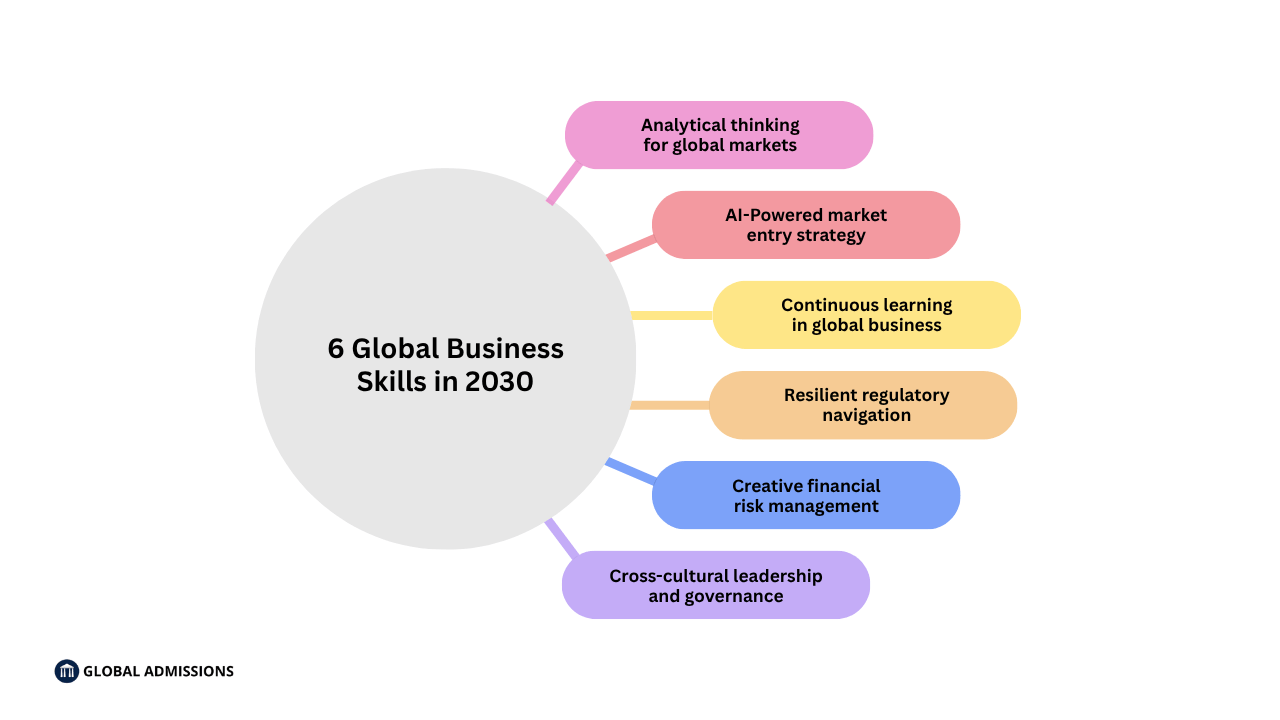
The 6 Skills that will define global business success in 2030
1. Analytical thinking for global markets
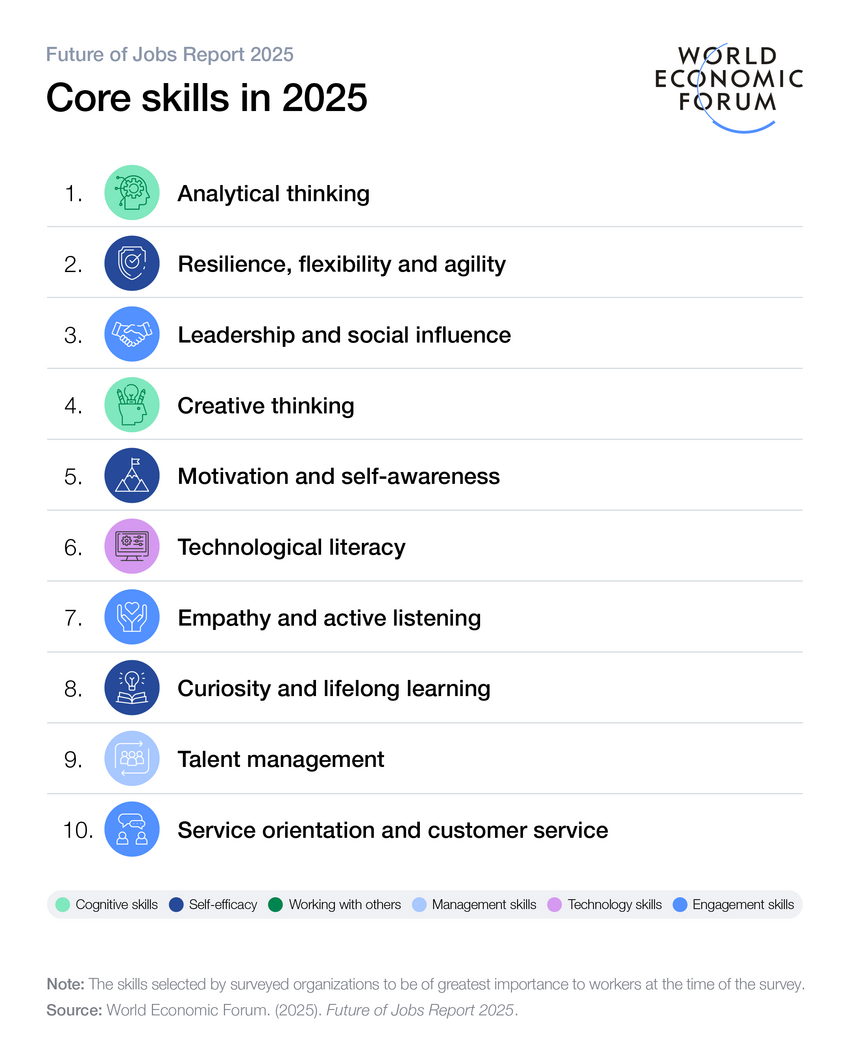
The World Economic Forum ranks analytical thinking as the top skill employers need, with 70% of companies considering it essential. But in global business, analytical thinking takes a specific form.
This means connecting dots across geographies, regulations, and market dynamics. How a new US administration affects trade with China. How European regulation affects tech companies. How Middle East tensions affect energy markets.
The analytical skill that matters is knowing which numbers matter and what story they tell about where markets are heading.
Using AI-powered market intelligence platforms to monitor policy shifts in real time helps. AI can track thousands of regulatory changes across jurisdictions and flag the ones that affect your business. You interpret what they mean and decide what to do about them.
This skill shows up in strategy teams analyzing market entry timing, regional managers deciding whether to expand or consolidate operations based on policy shifts, market entry analysts evaluating whether regulatory changes make a country more or less attractive, and international operations teams modeling how new sanctions affect supply chains.
2. AI-Powered market entry strategy
McKinsey research shows that demand for AI fluency has grown nearly 7 times in two years, faster than any other skill tracked in US job postings.
Knowing which markets to enter, when, and through which model requires understanding local competition, regulatory constraints, distribution channels, and consumer behavior. Should you enter through exports, joint ventures, acquisitions, greenfield investment, or licensing? What's the right pricing strategy? How do you adapt your product for local tastes while maintaining global brand consistency?
AI can help to model different market entry scenarios, analyze competitor positioning, and identify regulatory bottlenecks before you commit capital. AI can process vast amounts of market data faster than any human team. You bring the judgment about which risks are acceptable and which strategic tradeoffs to make.
3. Resilient regulatory navigation
The World Economic Forum ranks resilience, flexibility, and agility as the second most critical skill for 2030. Nearly 40% of current skills are expected to change by 2030. In global business, this resilience shows up most clearly in navigating regulatory complexity that keeps changing.
International business law varies by jurisdiction. Antitrust law, data privacy rules like GDPR in Europe or different regulations in China, labor law, environmental regulations like the EU's Carbon Border Adjustment Mechanism, and tax treaties all differ across borders. Compliance in one market doesn't guarantee compliance in another.
Resilient professionals don't just react to regulatory changes. They anticipate them, build flexibility into their operations, and adapt strategies when rules shift. When GDPR passed, companies that had built privacy-first systems adapted quickly. Companies that hadn't spent years and millions catching up.
Compliance teams ensuring operations meet local requirements across multiple jurisdictions, legal affairs professionals structuring contracts that work under different legal systems, risk management teams identifying regulatory exposure before it becomes a crisis, and international operations managers redesigning processes when new environmental or labor regulations take effect all need this skill.
4. Creative financial risk management
Creative thinking is considered one of the most essential skills for 2030. As AI takes over routine analysis, the human advantage shifts to solving problems that don't have a playbook. Financial risk management in global business is exactly this kind of problem.
Understanding foreign exchange exposure, international payments, hedging strategies, and financial risk in cross-border transactions is the baseline. Currency fluctuations can wipe out profits. Payment systems vary by country. But the creative part comes when you need to structure a deal that works under multiple regulatory frameworks, manage exposure to currencies that don't have liquid hedging markets, or design payment terms that satisfy a Chinese partner and a German bank simultaneously.
There's no textbook answer. You need fluency in financial instruments and the creativity to apply them to novel situations. AI can model thousands of FX scenarios and flag exposure automatically. You decide which hedging strategy makes strategic sense given your company's risk tolerance and market outlook.
5. Cross-cultural leadership and governance
Building leaders in the age of AI shows that the leaders who thrive will blend human depth with digital fluency. They can read a room, anticipate emotional reactions to change, and mobilize people across different cultural contexts.
In global business, leadership combines with governance in a specific way. You need to lead teams across time zones and cultures while understanding how corporate governance, stakeholder expectations, and the license to operate differ by jurisdiction. Cultural misalignment is consistently cited as a leading cause of failed international acquisitions and partnerships.
In the US, shareholder value is primary. In Germany, stakeholder capitalism includes workers and communities. In Japan, long-term relationships with suppliers matter more than short-term profits. You need to navigate these differences while leading effectively. AI cannot set an ambitious goal for a multicultural organization or interpret how a Chinese partner will respond to a contract proposal versus how a German partner will. That requires human judgment shaped by cross-cultural competence.
Any client-facing role working with international clients, leadership positions managing global teams, cross-functional roles coordinating between headquarters and regional operations, corporate governance teams ensuring compliance with different reporting and ethical standards, sustainability management positions balancing ESG requirements across markets, and government relations roles maintaining relationships with regulators in different countries all require this skill.
Cultural differences significantly impact business practices. Power distance, decision-making styles, and risk tolerance vary dramatically across countries.
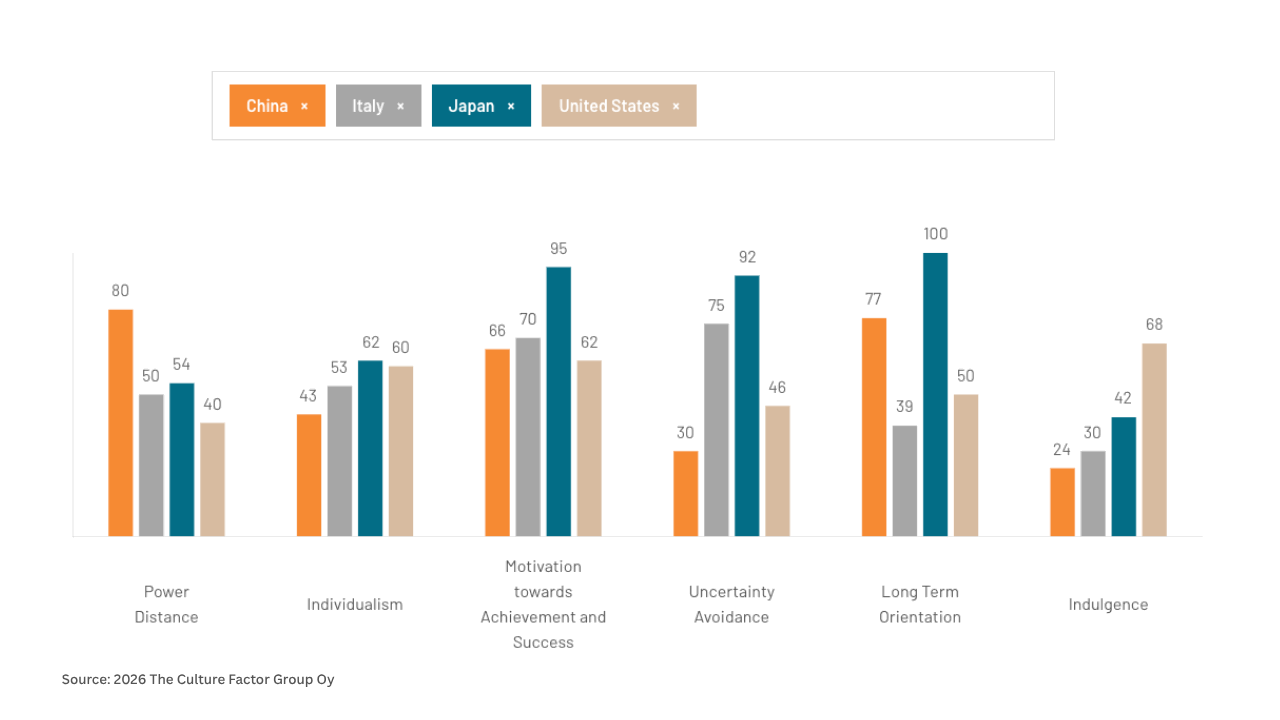
Cultural differences significantly impact business practices. Power distance, decision-making styles, and risk tolerance vary dramatically across countries.
6. Continuous learning in global business
The World Economic Forum identifies curiosity and lifelong learning as a core skill rising in importance. What you learn today may be less relevant in five years. Our eagerness to learn, adapt, and stay open is what keeps us competitive.
The ability to keep learning becomes the meta-skill that enables everything else. Staying current on trade policy shifts, understanding how new data privacy regulations affect operations, learning how emerging markets are leapfrogging traditional development patterns, and adapting to new technologies and business models as they emerge.
The goal is not to become an expert in everything, but to stay curious enough to ask the right questions and adapt fast enough to remain effective. When AI tools improve, you learn how to integrate them into your workflow.
Every role in international business requires continuous learning because markets, regulations, and technologies keep changing. The professionals who thrive are the ones who treat learning as part of the job, not something you do before the job starts.
Continue reading:
- 11 Top Universities Offering Free Online Courses to Upskill in 2026
- 10 Best Business Universities in Italy
Explore Programs