


The competition for university spots in traditional destinations like the US, UK, Canada, and Australia is getting tighter. Visa caps, rising costs, and longer processing times are pushing students to look elsewhere.
If you're exploring your options, you're not alone. The global education market is shifting, and a new group of countries is emerging as serious alternatives.
The Changing Map of International Education
According to recent data from UNESCO and QS Global Student Flows, international student numbers are projected to reach 8.5 million by 2030. But where those students are going is changing fast.
South Korea hit its target of 300,000 students two years ahead of schedule, and Seoul is now ranked as the top student city in the world. The UAE saw a 90% increase in search interest, driven by students looking for quality education in a modern, international environment.
These aren't small shifts. Italy reported 14% overall growth, with Indian student numbers growing five to seven times in some regions. Ireland, the only English-speaking country in the Eurozone, has seen four straight years of record growth. Malaysia is on track to reach 260,000 international students by 2030.
Why Students Are Looking Beyond the Big Four
The reasons are straightforward. Cost is a major factor. Only 12% of students say affordability doesn't influence their choice, which explains why Germany (with low or no tuition fees) and Italy are becoming so popular.
But it's not just about money. US F-1 visa issuances for Indian and Nigerian students dropped 30-40% in recent years. Canada introduced severe study permit caps. Australia implemented enrollment restrictions. When access becomes uncertain, students move to more welcoming destinations.
The pattern is clear: if a country makes it harder to study there, students don't wait around. They find alternatives that they want them.
What Makes These Rising Destinations Attractive
The countries gaining students share common advantages. They offer quality education, English-taught programs, affordable tuition, and realistic pathways to work after graduation.
Japan introduced the J-Find visa program specifically to retain international graduates for its workforce. Spain launched a fast-track visa to attract students facing hurdles elsewhere. New Zealand saw a 34% rebound in Indian applications as Australia tightened its policies.
Poland has become a hub for affordable engineering and medical degrees taught in English. Portugal is popular with students looking for lower living costs and a growing tech scene. Finland and the Nordic countries are attracting STEM students with their focus on innovation and high quality of life.
The Branch Campus Option
Here's a trend worth paying attention to: branch campuses. Why pay UK prices to study in London when you can earn the exact same University of Nottingham degree in Malaysia at half the cost?
This model is expanding rapidly across Asia and the Middle East. Malaysia, UAE, Singapore, and China are all hosting branch campuses from prestigious Western universities. You get the same degree certificate, often with the same faculty and curriculum, but without the visa complications and at a fraction of the price.
For many students, particularly from Asia, Africa, and the Middle East, this is the best of both worlds.
List of Rising Destinations for International Students
Europe: The Hyper-Growth Destinations
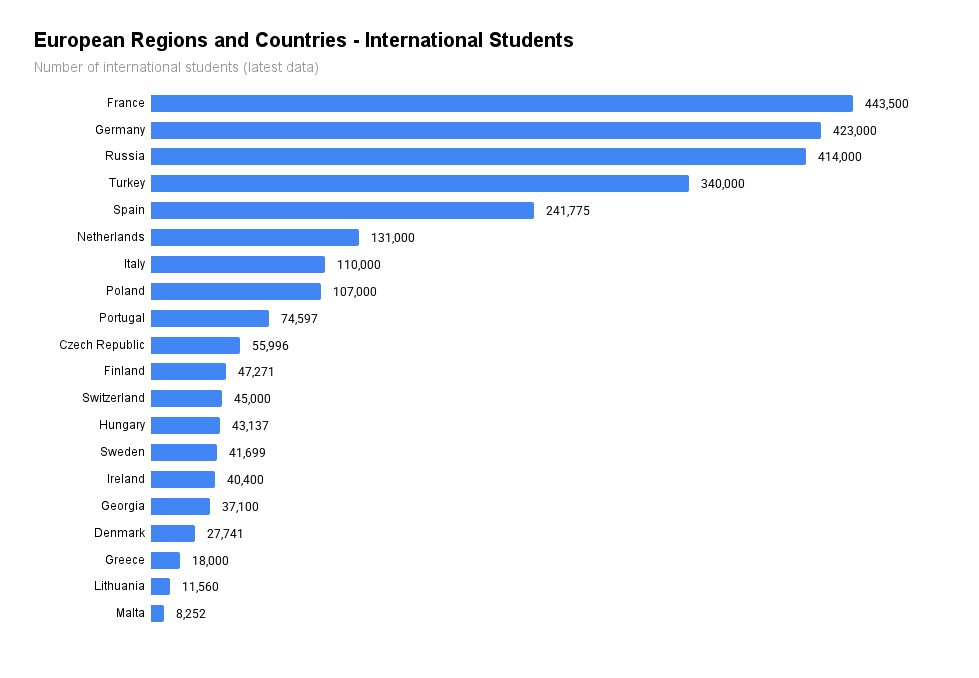
Germany has reached 423,000 international students in 2025. The combination of low tuition fees (often free at public universities), strong engineering programs, and post-study work opportunities makes it a top choice for students worldwide.
Russia has reached more than414,000 international students from 184 countries in 2025, marking a record-high enrollment that keeps the country firmly in the global top 10 for education. This growth is part of a national strategy to host 500,000 foreign students by 2030, driven by the expansion of government-funded quotas, which reached 30,000 annual spots in 2025, and the increasing popularity of English-taught medical and engineering degrees.
Ireland has reached a record 40,400 international students in 2024, a 10% increase from the previous year. As the only English-speaking country in the Eurozone, it offers EU access with familiar language instruction. Indian student numbers are up 30%, and American enrollments increased 8%.
Italy reported 110,000 international students in 2024 (14% overall growth from 2019), with Indian student enrollment growing five to seven times in some regions. The country offers affordable education, rich cultural heritage, and an increasingly diverse range of English-taught programs. Decreto Flussi Reform 2026 marks the start of a plan to issue 500,000 work visas over three years, specifically easing the path for graduates.
Spain launched the "EduBridge" fast-track visa specifically designed to attract students facing US visa hurdles. The country is positioning itself as an affordable, culturally rich alternative with growing English-taught program offerings. The ministry reported that there were 241,775 international students in 2023.
Netherlands reported 131,000 international students in 2025 and remains a top choice for English-taught research programs, despite some local enrollment caps. The country’s strong international orientation and high quality of life continue to attract students.
Poland reported 107,000 international students in 2024, rapidly becoming a hub for affordable engineering and medical degrees taught in English. The country offers EU access at significantly lower costs than Western Europe.
Portugal is popular with students seeking lower living costs, a growing tech scene, and increasingly digital nomad–friendly policies that also benefit students. According to the latest data (2023), the country hosted 74,597 international students.
France reported 443,500 international students in 2025, and remains a top five global destination but is actively working to diversify its student base beyond Francophone Africa. The country offers quality education at public university rates significantly lower than Anglophone destinations.
Denmark is the largest receiver of intra-Nordic mobility. According to the latest data (2024), the country hosted 27,741 international students.
Sweden is recovering popularity due to high innovation rankings. According to the latest data (2024), the country hosted 41,699 international students.
Finland is leading the "Nordic Rise" with aggressive STEM talent attraction. In 2024, there were 47,271 international students.
Switzerland remains a consistent leader for hospitality management and high-end research, though costs are significantly higher than other European options. In 2023, there were over 45,000 international students.
Czech Republic is growing for medicine and technology programs at affordable rates. In 2024, the country hosted 55,996 international students.
Hungary is seeing success with its Stipendium Hungaricum scholarship program, which covers tuition and living expenses for qualified students. In 2024, there were 43,137 international students.
Greece is launching new English-taught humanities programs at lower costs than Western Europe. There were 17,000 - 18,000 international students in 2025.
Georgia currently hosts 37,100 international students, according to statistics for the 2024–2025 academic year. The country continues to attract students with its affordable tuition fees, straightforward admission process, and growing reputation for medical and business programs.
Lithuania recorded 11,560 international students enrolled at its universities in the 2024–2025 academic year. Known for its affordable tuition fees, strong programs in technology and business, and growing startup ecosystem, Lithuania is becoming an attractive option for students seeking quality education within the European Union.
Malta recorded 8,252 international students in 2024. It remains a niche but vital Mediterranean hub for English-language instruction and maritime-related studies.
Turkey is now a top 10 global destination with over 340,000 international students in 2025. Its strategic location between Europe and Asia, affordable costs, and growing English-taught programs make it increasingly attractive.
Asia-Pacific: The Regional Powerhouses
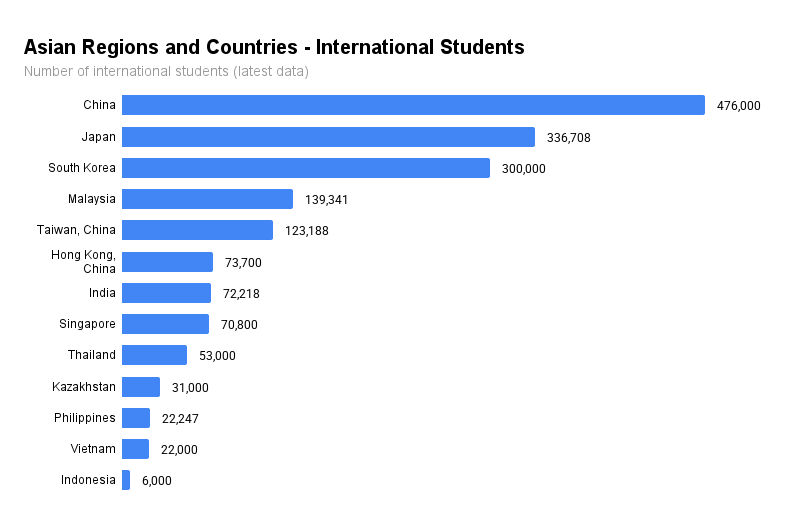
South Korea reached its 300,000 international students target two years early. Seoul is now ranked as the number one student city in 2026, offering a blend of technological innovation, cultural appeal, and growing English-taught programs.
Japan is implementing aggressive J-Find visa policies designed to retain 400,000 international graduates for its workforce. The country offers quality education, safety, and clear post-graduation pathways. In 2024, there were 336,708 international students.
Malaysia is reporting a 26% increase in international applications and is on track to reach 260,000 students by 2030. Recorded 139,341 international students in 2025. The country has positioned itself as Southeast Asia's transnational education hub, hosting branch campuses from UK, Australian, and American universities. Students can earn a University of Nottingham or Monash degree at half the UK or Australian price.
Singapore reached 70,800 international students in 2023 and serves as the premium hub for AI and business education in Asia. While more expensive than regional alternatives, it offers world-class education and strong career prospects.
Hong Kong hosted approximately 73,700 international students from over 100 countries in the 2023/24 academic year, with the government recently doubling the non-local student quota at public universities to 40% to expand its regional influence.
Taiwan recorded 123,188 international students in 2024, a five-year high driven by significant growth from Vietnam and Indonesia.
Vietnam saw search demand for bachelor's programs rise 101% year-on-year. The country is emerging as a destination for branch campuses and regional students. According to the latest data from the Ministry of Education and Training, about 22,000 foreign students are studying in Vietnam at higher education institutions in 2024.
India recorded 72,218 foreign students in 2025 from nearly 200 countries, driven by the government's "Study in India" initiative.
Indonesia reported a 38% rise in student interest and is positioning itself as a Southeast Asian education powerhouse. Around 6,000 international students are currently studying in Indonesia, many coming from nearby Malaysia.
Thailand remains a popular destination for its affordable branch campuses and hospitality programs, recording over 53,000 international students in 2024.
Kazakhstan is strengthening its status as Central Asia's education star, hosting 31,000 international students from 88 countries in 2025, an 11% increase from the previous year.
The Philippines serves as a major global hub for medical education and English language training, particularly for students from Asia and the Middle East. As of 2022, the country hosted 22,247 international students, representing a 52.7% growth since 2017, with Indian and Chinese nationals comprising the largest student groups.
Middle East & North Africa: The Emerging Hubs
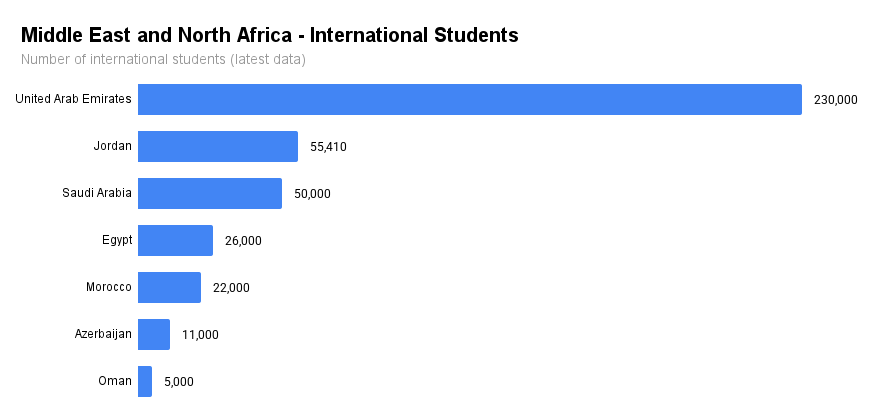
The United Arab Emirates has reached a major milestone, hosting over 230,000 international students in 2025 from more than 200 countries. This growth is part of a broader surge in demand, with international study interest in the UAE soaring by 90% in mid-2025 alone.
Saudi Arabia is investing billions in its "Study in Saudi" initiative as part of its economic diversification strategy and currently hosts over 50,000 international students. The country is building entire education cities and offering extensive scholarships to attract global talent.
Egypt recorded 26,000 international students in 2023 and is positioning itself as an affordable education hub for the Middle East and Africa.
Morocco hosted 22,000 international students in 2022, serving as a rapidly growing gateway for French-speaking African education.
Jordan recorded 55,410 international students in 2025, specializing in highly sought-after Arabic language and humanities programs.
Oman recorded 5,000 international students in 2025 as part of its strategic investment in new "Education Cities".
Azerbaijan recorded approximately 11,000 international students in 2024, driven by increasing interest in its energy and engineering programs.
Latin America: The Regional Leaders
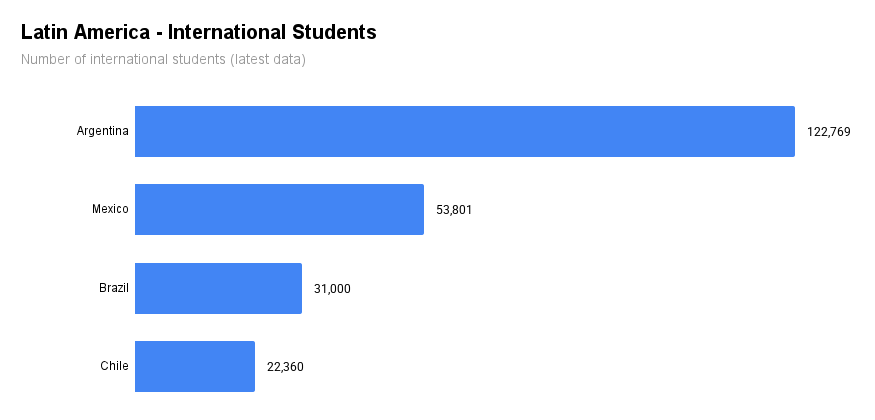
Mexico hosted 53,801 international students in 2023, representing a 175% increase over the past seven years. The country is increasingly attractive to U.S. students, with a 53% surge in American study-abroad enrollment recently, who seek affordable, nearby exchange options and a growing variety of cultural programs.
Brazil serves as the regional leader for research and Portuguese-language education, recording approximately 31,000 international students in 2024. Its extensive higher education network includes over 2,600 institutions, with top-tier public universities acting as major anchors for South American and Lusophone African student flows.
Argentina offers affordable education and renowned humanities programs, hosting 122,769 international students in its universities as of 2024. The capital, Buenos Aires, remains a primary global hub, attracting over 50,000 foreign learners annually, the majority of whom originate from neighboring South American countries like Brazil and Colombia.
Chile recorded 22,360 international students in 2024 and remains a top choice for those pursuing business and Latin American studies. The country continues to bridge the gap with global education benchmarks, with international mobility focused on its highly ranked private and public research institutions.
Africa: The Continental Hubs
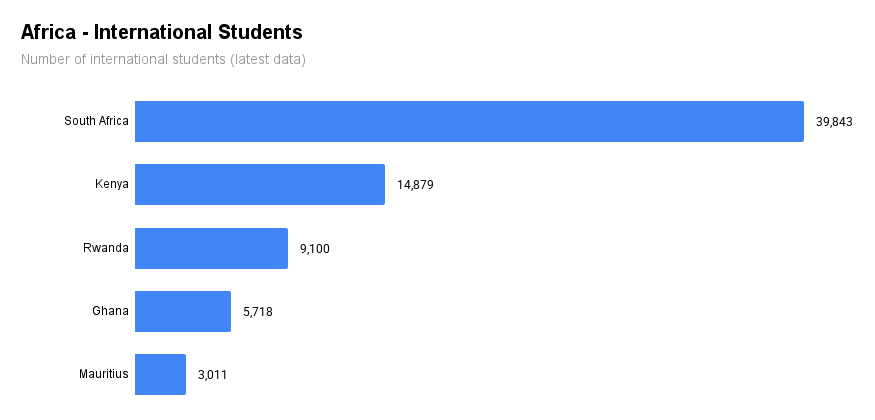
South Africa reported 39,843 international students in 2023, maintaining its position as a major regional hub despite a slight decline in its overall student share. Zimbabwe remains the leading source of these enrollments, which are increasingly distributed between traditional contact and distance learning modes.
Ghana recorded 5,718 international students in 2020 and continues to rise as a hub for West African regional mobility. While primarily known for its rapidly growing outbound population, the country remains a strategic education center for students within the ECOWAS region.
Kenya is emerging as a critical East African tech hub, with the Commission for University Education (CUE) reporting a total of 14,879 international students enrolled across Kenyan universities for the 2024/2025 academic year.
Mauritius hosts 3,011 international students as of 2024, actively positioning itself as an "international education island" with a dedicated Ministry for Tertiary Education and new 2025–2029 strategic pillars aimed at attracting global talent.
Rwanda has experienced a rapid surge in its international student population, growing from roughly 1,400 students in 2017 to over 9,100 by 2024. The country is frequently cited as a prime example of "smart internationalization" in East Africa due to its welcoming policies and expanding higher education sector.
What This Means for You
The expansion of viable study destinations gives you leverage. You're no longer dependent on getting a visa to one of the Big Four countries. You have options across every continent, in multiple languages, at various price points.
The countries seeing the most growth are those making it easier for students to apply, study, and work after graduation. They're responding to market demand with clear policies, streamlined processes, and genuine welcome.
When choosing your destination, consider the full package: tuition costs, living expenses, language requirements, post-graduation work rights, safety, and career prospects in your field.
The Big Four Countries: Still Dominant but Constrained
USA remains the number one destination by total volume but is seeing significant headwinds. F-1 visa issuances from India and Nigeria dropped 30-40%, pushing students to explore alternatives.
The UK remained popular through 2025, but 2026 interest is dipping due to dependent visa bans and tightening post-study work policies.
Canada has implemented severe study permit caps, leading to a "wait and see" attitude from prospective students.
Australia introduced National Planning Levels (enrollment caps) for 2026, limiting growth and pushing students toward New Zealand and other alternatives.
These countries still offer world-class education, but access has become less certain and more expensive.
Making Your Decision
This is good news for many international students. You have more quality options at more price points than any previous generation of international students.
Don't limit yourself to the traditional four destinations just because that's where everyone used to go. The universities seeing the most growth right now are those in countries that actively want international students and make the process straightforward.
Do your research. Compare not just tuition but total cost of living. Look at visa success rates and post-graduation work rights. Talk to current students from your country at universities you're considering. Understand what employers in your home country or target career market value.
The right choice is the one that gets you the education you need, in a place you can afford, with a clear path to your career goals. That might be Germany, Malaysia, South Korea, or somewhere you haven't considered yet.
The world is open. Where will you go?
You can search 100,000+ programs worldwide in Global Admissions for you to compare.
Sources:
This article draws on data from official government sources, international organizations, national statistical agencies, and reputable education news outlets. All figures represent the most recent available data as of 2026.
- OECD - Organisation for Economic Co-operation and Development
- IIE Project Atlas (Institute of International Education)
- Statista
- QS Top Universities
- University World News
- The PIE News
- ICEF Monitor
- EduRussia
- Nuffic
- Statistics Poland (GUS)
- Campus France
- Czech Statistical Office.
- MSM Unify
- DAAD
- BM.ge
- Anadolu Agency
- Nippon.com
- The Star (Malaysia)
- Business Times Singapore
- Study in Hong Kong
- Focus Taiwan
- Nhan Dan
- Thailand Government
- QazInform (Kazakhstan)
- Times of India
- Saudi Gazette
- Morocco World News
- Petra News Agency
- State Information Agency of Azerbaijan
- INEP Brazil
- Department of Higher Education and Training, South Africa
- Ghana Investment Promotion Centre (GIPC)
- Eastleigh Voice (Kenya)
- Tertiary Education Commission, Mauritius
- Africa Press
