


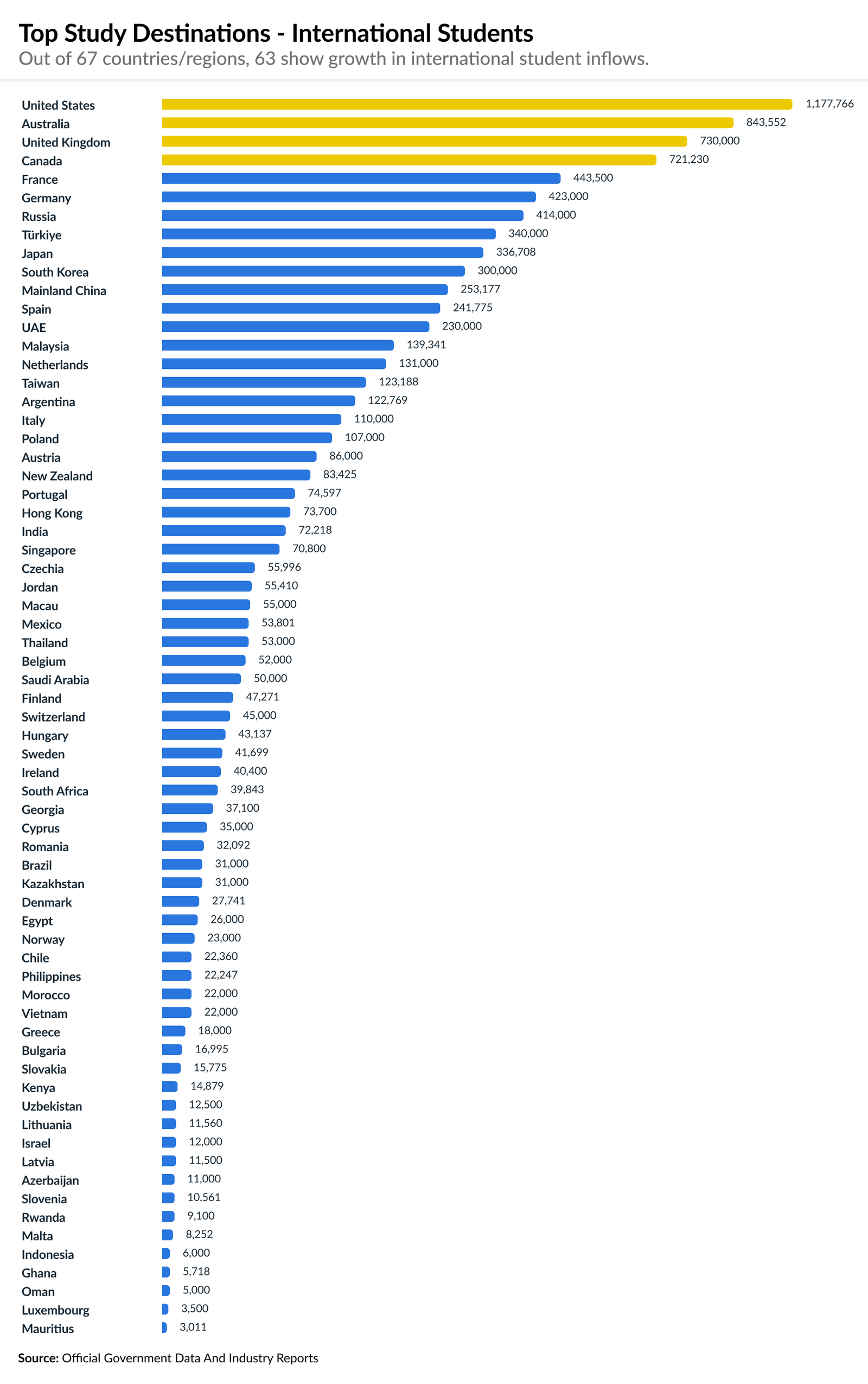
For years, the US, UK, Canada, and Australia controlled most of the international student market. That hold is slipping.
US F-1 visa approvals for Indian and Nigerian students dropped 30 to 40% in recent years. Canada capped study permits and froze out thousands of applicants. Australia set enrollment limits at the institution level for 2026. The UK's post-study work rules are getting tighter, and interest is already dipping.
Students are not waiting to see if things improve. They are moving.
South Korea hit 300,000 international students two years ahead of its own target. Germany now hosts 423,000, largely because public universities charge zero tuition. The UAE saw a 90% spike in international study interest in mid-2025 alone. These are not minor fluctuations. The global student market is redistributing, and the countries gaining students are the ones that made it straightforward to apply, study, and stay after graduation.
There are already over 9 million students studying abroad worldwide based on Global Admissions' country-by-country analysis of official national statistics, across destinations that most industry reports overlook, adjusted upward to account for the 1-2 year reporting lag in most government datasets. By 2030, projections for international student mobility vary significantly depending on methodology. QS projects over 8.5 million international students worldwide. Some industry reports suggest the number could reach 10 million. Our methodology - aggregating live enrollment trends, recent policy shifts, and growth rates in emerging destinations - leads to a higher figure. We predict international student mobility will exceed 11 million by 2030.
This article breaks down which destinations are rising, what is driving students there, and what the data says about where the market is heading.
The Big Four Are Losing Ground
The traditional powerhouses: USA, UK, Canada, and Australia, remain the world's largest destinations by volume, but all four experienced significant declines in 2024-2025, marking a historic turning point driven by restrictive policies and market saturation.
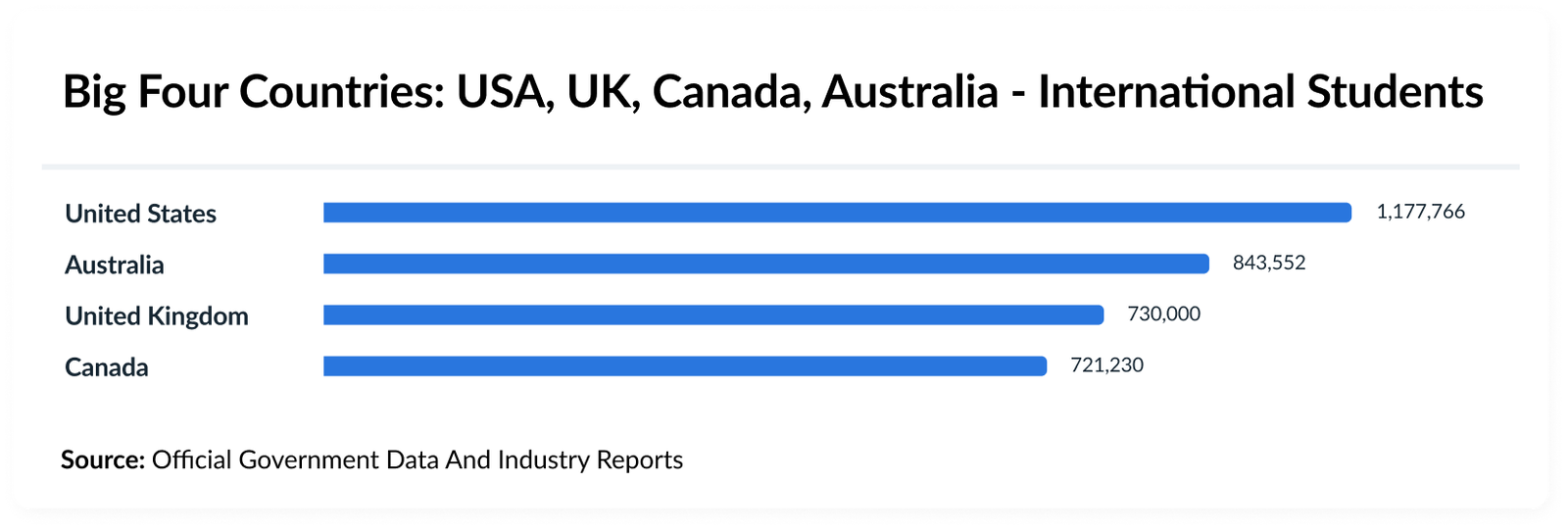
United States | 1,126,690 (2024) | 1,177,766 (2025) | +4.5% |
Australia | 851,010 (2024) | 843,552 (2025) | -0.9% |
United Kingdom | 758,855 (2023) | 730,000 (2024) | -3.8% |
Canada | 997,820 (2024) | 721,230 (2025) | -28% |
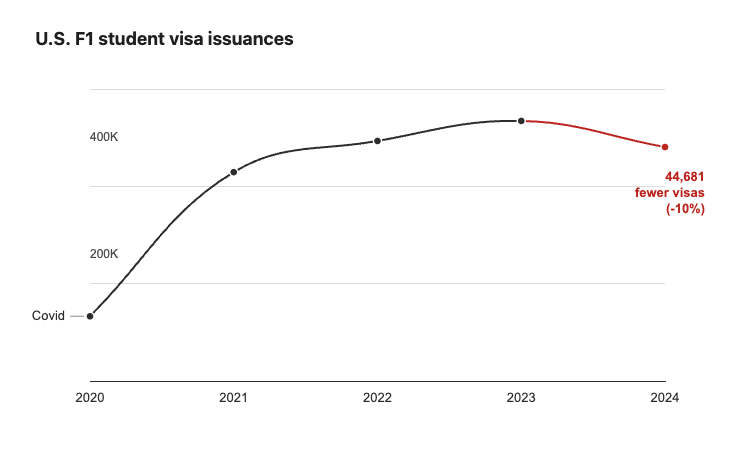
United States hosts approximately 1,177,766 international students as of 2025, but the trajectory is troubling. F-1 visa issuances dropped 14% in the first five months of 2025 compared to 2024, with a 22% decline in May 2025 alone. Fall 2025 enrollment data revealed a 17% decline in new students and 7% overall decline. Early projections suggest enrollment drops of 7-11% for 2025-26, translating to 80,000-145,000 fewer students. Applications from India, historically the largest source of US international students, fell sharply. Nigeria saw similar declines.
Canada introduced its study permit cap in January 2024 with a target of 35% fewer new approvals. The actual outcome went further. IRCC data shows only 267,890 new study permits were issued in 2024, a 48% drop from 2023 levels and nearly 100,000 below the government's own target. Colleges took the sharpest hit. In Ontario, 23 of 24 public colleges reported a 48% enrollment decline between September 2023 and September 2024. Over 600 programs were cancelled or suspended by spring 2025, and more than 8,000 staff were laid off across the province. The cap extended into 2025 and 2026 with further 10% reductions each year, and for the first time, master's and doctoral students were brought under the cap limit. For 2026, Canada set a ceiling of 155,000 new study permits, a 49% cut from 2025 levels.

Australia's National Planning Levels for 2026 give the government direct control over how many international students each institution can enroll. Universities that grew aggressively on international tuition revenue are now operating under formal ceilings. New Zealand picked up a 34% rebound in Indian applications almost immediately after Australia tightened its rules.
The UK retained strong numbers through 2025, but the dependent visa ban introduced in 2024 removed a key draw for postgraduate students with families. Post-study work rights under the Graduate Route are under ongoing political pressure, and early data shows 2026 interest from key source markets softening.
All four destinations implemented restrictive policies in 2024-2025 that fundamentally altered their accessibility. These countries still offer world-class education, but access has become less certain, more expensive, and politically fraught.
Where Students Are Going Instead - The Rising 63
Europe
The European higher education market is experiencing unprecedented growth as students recalibrate their choices in response to tightening visa policies and rising costs in traditional Anglophone destinations.
The value proposition is straightforward: comparable education quality at a fraction of the cost, with clear post-graduation pathways and EU mobility benefits.
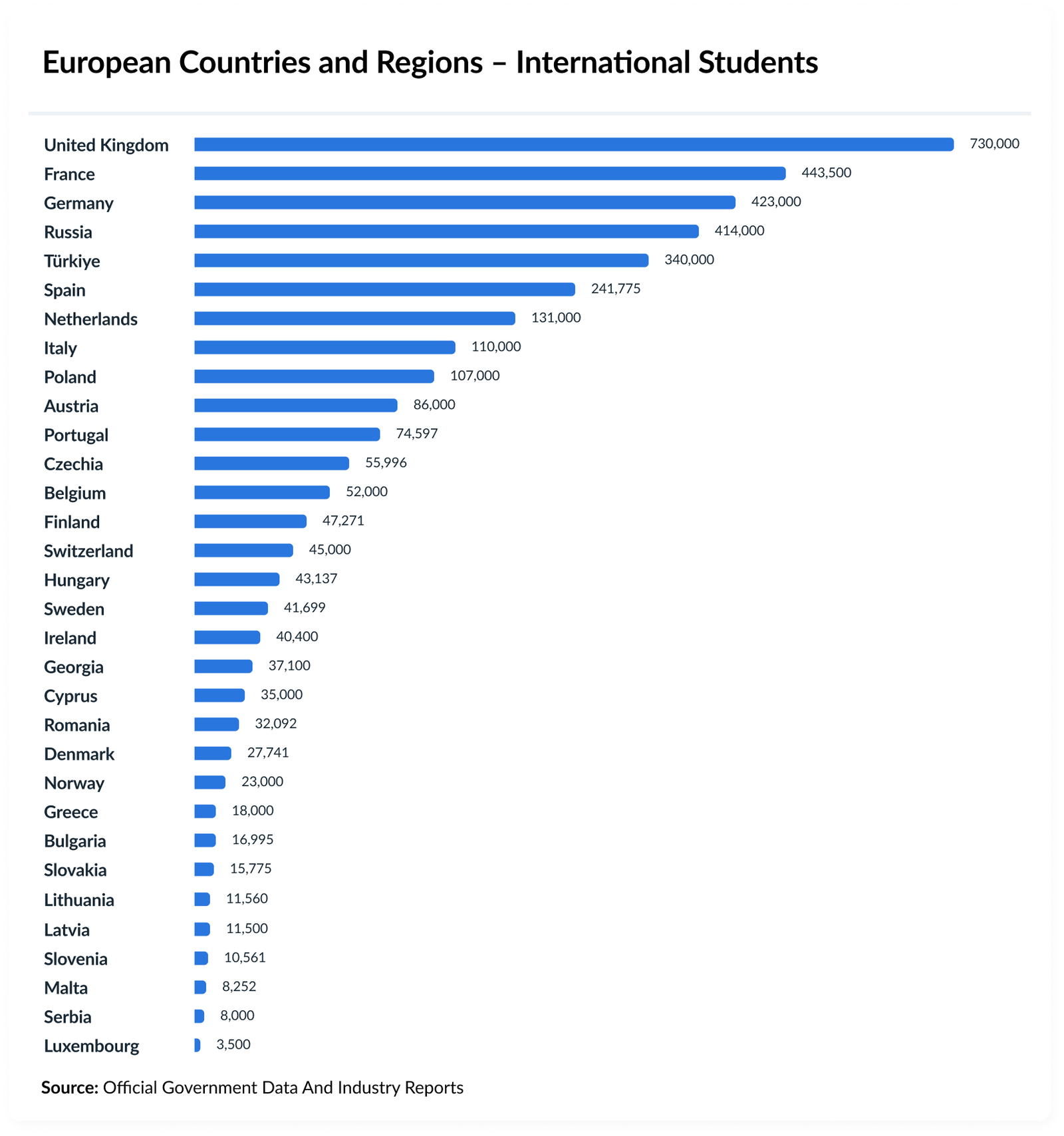
Germany now hosts 423,000 international students, making it the number one non-English-speaking destination globally. Ireland crossed 40,400 international students in 2024, a 10% increase year-on-year, as the only English-speaking country in the Eurozone.

Indian student numbers in Ireland are up 30%, reflecting a broader pattern of diversification away from traditional markets facing visa restrictions.
Italy reported 110,000 international students in 2024, up 14% from 2019, with Indian enrollment in some regions growing five to seven times over. The government's Decreto Flussi Reform 2026 opens 500,000 work visas over three years, specifically easing pathways for graduates to stay.
What's driving this European surge is the combination of low cost, quality education, and realistic post-study work pathways.
Asia and Australasia
The Asia-Pacific region is experiencing remarkable growth in international education, driven by strong government strategies, competitive pricing, and expanding English-taught programs. Students across the region are increasingly weighing regional alternatives against Western destinations, driven by cost considerations, geopolitical factors, and a growing recognition that quality education exists closer to home.
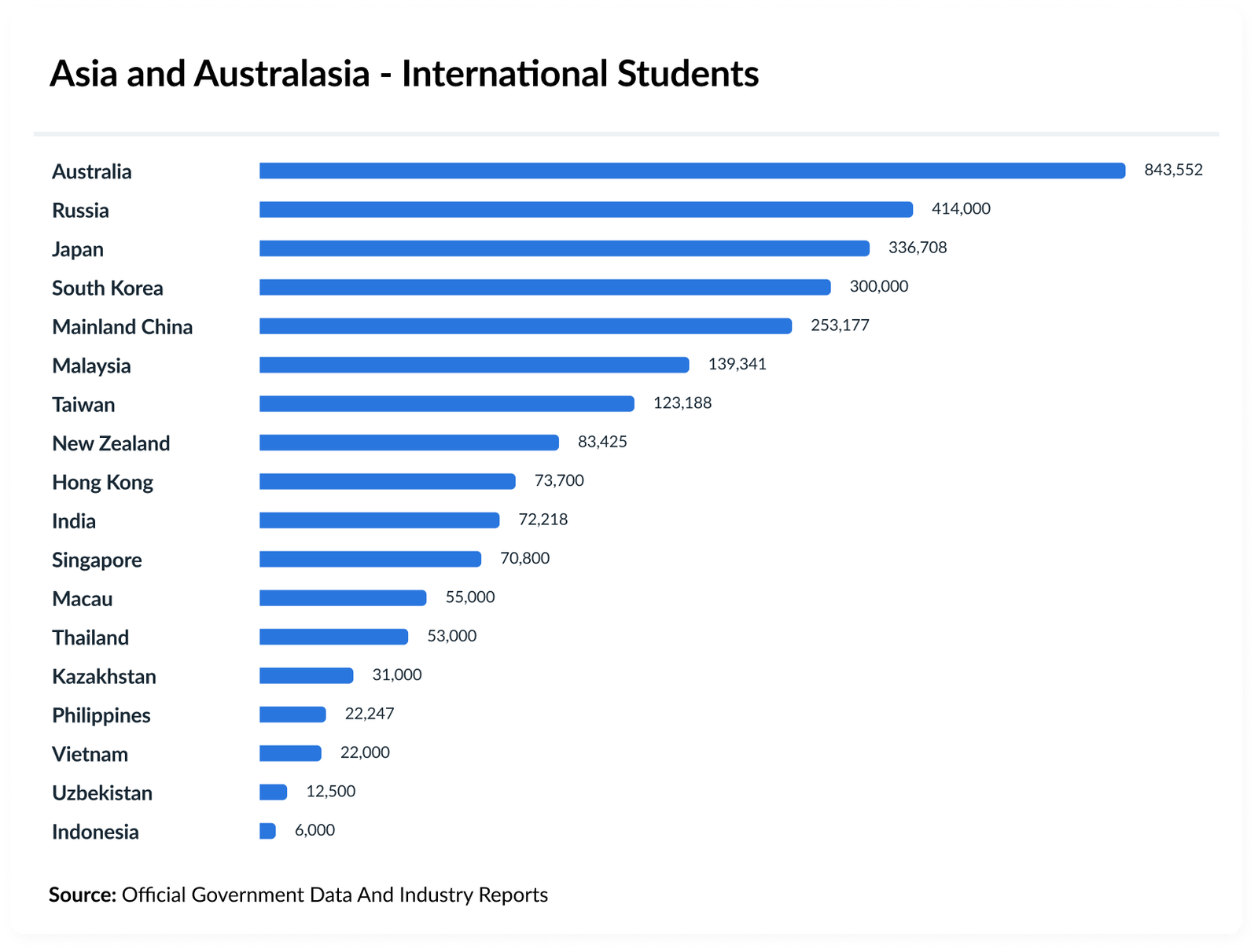
Western visa restrictions, rising costs, and longer processing times are pushing students to reconsider traditional destinations, while Asia-Pacific countries pull them in with geographic proximity, English-taught programs, and clear post-graduation work policies.
Countries like Japan introduced the J-Find visa to retain 400,000 international graduates for its aging workforce. South Korea gave universities freedom to design programs in global entertainment, AI, and engineering without government restrictions. Malaysia's branch campus model has fundamentally changed the value proposition, students earn UK and Australian degree certificates, often with the same faculty, at roughly half the price.

Cultural factors play a role that's often underestimated: Korean universities capitalize on K-pop's global influence, Japan attracts students interested in robotics and animation, and Singapore's position as a financial hub creates clear career pathways.
Yet the region faces headwinds. Geopolitical tensions, safety concerns, and political stability all factor into student decisions. China, historically a major regional destination, has not released official international student enrollment figures in recent years, the most recent data is from 2022 showing 253,177 students.
Middle East and North Africa
The Middle East and North Africa region is redefining what international education can look like outside of Western markets. The growth is driven by a different value proposition: access to Western-branded education in a geographically convenient, culturally familiar environment with fewer visa complications.
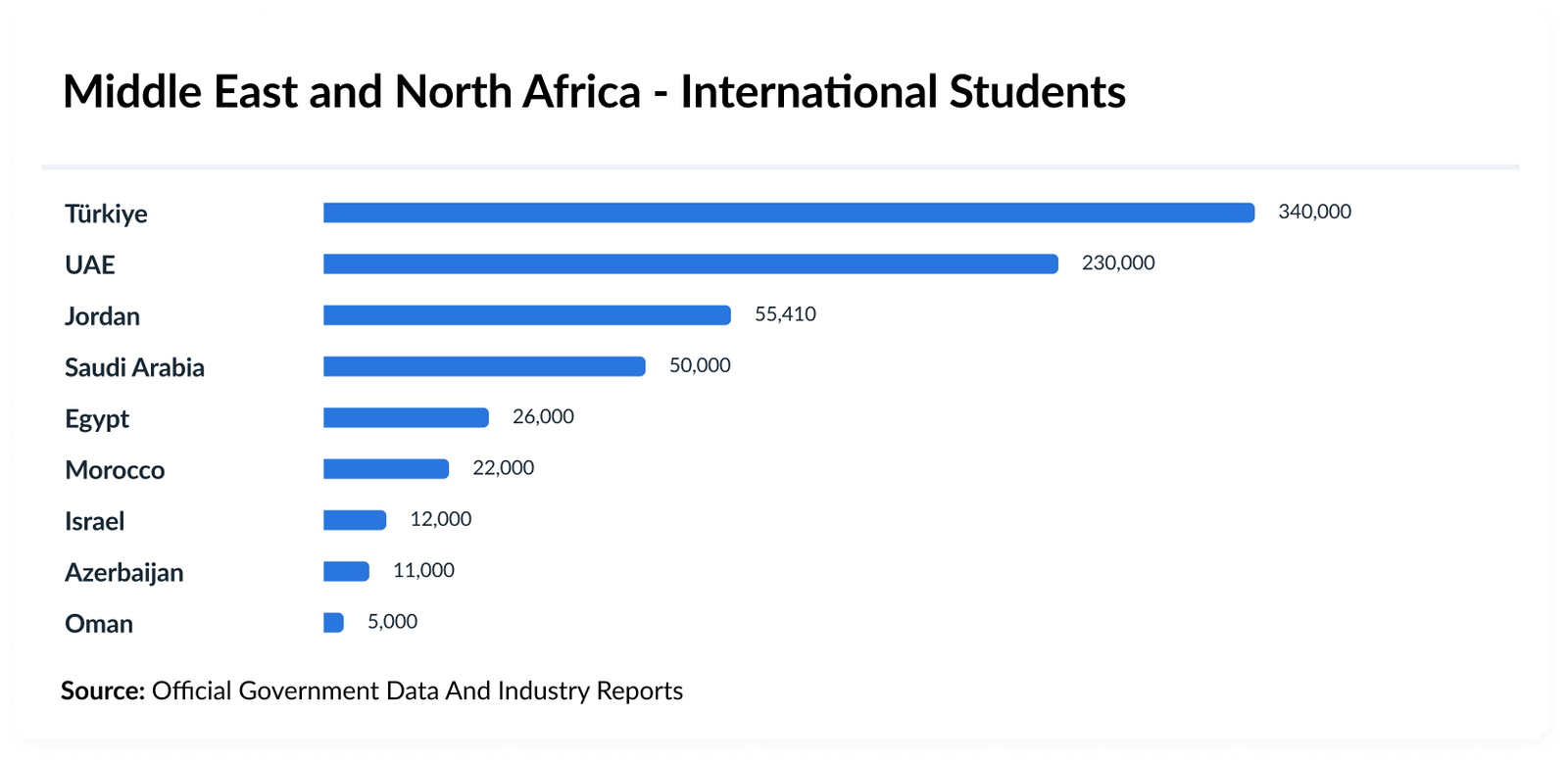
For students from South Asia, Africa, and the Middle East, studying in Dubai or Riyadh offers international credentials without the visa uncertainty and cultural distance of moving to London or New York.
The UAE saw a 90% increase in international study interest in mid-2025 and now hosts over 230,000 international students from more than 200 countries.
The driver is the branch campus model at scale: students attend New York University Abu Dhabi, Heriot-Watt Dubai, or Middlesex University Dubai and receive the exact same degree as students on the home campus. Students cite the quality of institutions, the international environment, and post-graduation work access as the main reasons for choosing the UAE.
Türkiye has quietly become a global top 10 destination with over 340,000 international students, leveraging its strategic position between Europe and Asia, affordable costs, and growing English-taught programs. Its appeal lies in being culturally accessible to students from Central Asia, the Middle East, and North Africa while offering pathways to European-style education.

Saudi Arabia is investing billions in its "Study in Saudi" initiative as part of Vision 2030's economic diversification strategy and currently hosts over 50,000 international students. The country is building entire education cities and offering scholarships to position itself as a knowledge economy hub.
The MENA region's growth reflects a broader pattern: students are choosing destinations based on practical considerations: cost, visa accessibility, cultural fit, and employment prospects. For many students, particularly those from neighboring regions, studying in Dubai or Istanbul offers better value and clearer pathways than attempting to navigate increasingly restrictive Western visa systems.
Latin America
Latin America's international education landscape is defined by intra-regional mobility and proximity appeal. Unlike Europe or Asia-Pacific, where students are actively choosing regional alternatives to Western destinations, Latin American growth is driven by different dynamics: neighboring students seeking affordable Spanish or Portuguese-language education, U.S. students looking for nearby exchange options, and a handful of countries positioning themselves as regional research hubs.
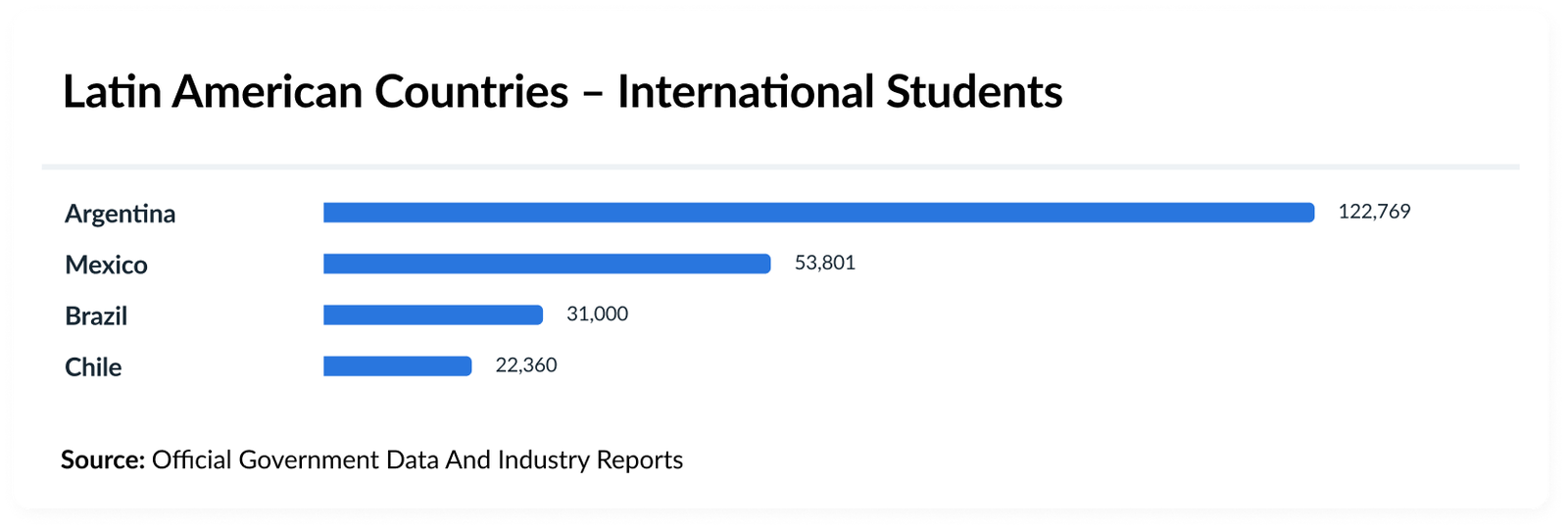
Mexico hosted 53,801 international students in 2023, positioning itself as an increasingly attractive option for North American exchange programs. The draw for U.S. students is straightforward: geographic proximity, lower costs than domestic institutions, and growing cultural program offerings without the complexity of long-haul travel or significant time zone differences.

Brazil serves as the regional leader for research and Portuguese-language education with approximately 31,000 international students in 2024, leveraging its extensive higher education network of over 2,600 institutions.
Argentina offers affordable education and renowned humanities programs, with Buenos Aires attracting over 50,000 foreign learners annually as a primary global hub for the region. Yet economic instability creates uncertainty, while tuition remains low, currency fluctuations and political changes make long-term planning difficult for international students.
The broader Latin American story is one of potential constrained by infrastructure gaps, economic volatility, and limited English-taught program offerings. For students within the region, these countries offer accessible, culturally familiar education. For students outside Latin America, they remain niche choices rather than mainstream alternatives to Europe, Asia-Pacific, or North America.
Africa
Africa's international education landscape operates on a fundamentally different scale than other regions, shaped by economic constraints, infrastructure gaps, and the reality that most African students who study internationally leave the continent rather than move within it.
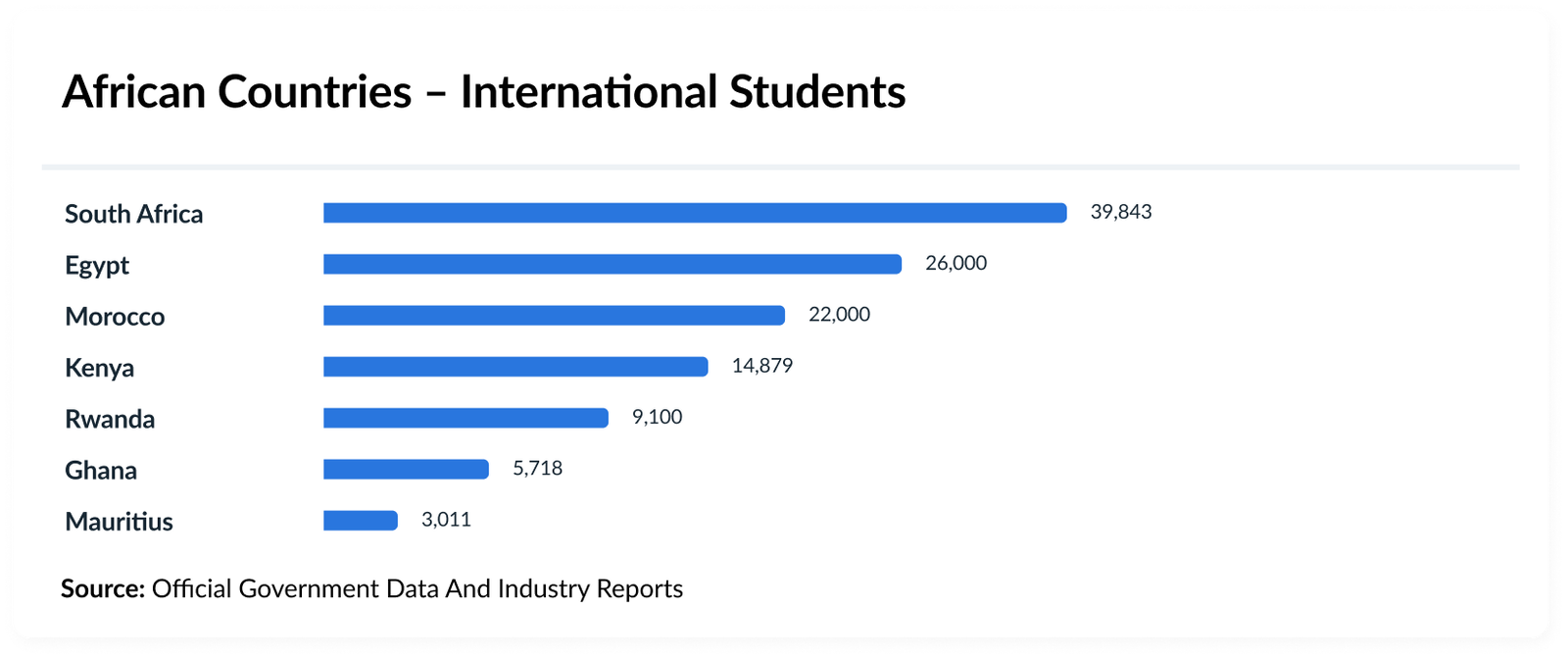
South Africa serves as the primary destination for sub-Saharan African students, leveraging its relatively developed higher education infrastructure and English-language instruction. Kenya is gaining ground through investments in technology education and positioning Nairobi as a regional innovation hub, attracting students from neighboring East African countries.

Rwanda's growth demonstrates what's possible with intentional policy, nearly sevenfold enrollment increases in seven years reflect the government's focus on creating a welcoming environment for international students as part of broader economic development goals.
Ghana recorded 5,718 international students in 2020, rising as a West African regional hub, while Mauritius positions itself as an international education island with 3,011 students, leveraging connections to both African and Asian markets.
The challenge for African destinations is competing not just with Western countries but with regional alternatives in Asia-Pacific, Europe, and the Middle East that offer similar or lower costs with better infrastructure and more robust post-graduation opportunities.
For African students considering international study, the calculation often favors leaving the continent entirely, pursuing degrees in Europe, North America, or increasingly in Asia-Pacific and the Middle East where scholarships, employment prospects, and quality assurance are more established.
African countries capturing international students are doing so primarily through intra-regional mobility, serving neighboring countries rather than attracting global flows. The next phase of growth will depend on whether governments can sustain investment in quality, infrastructure, and graduate employability to make African institutions competitive beyond the immediate region.
What Is Driving Students to These Destinations
Cost is the clearest factor. 77% of international students rank affordable tuition as the top factor in their study destination decision. Germany's zero-tuition model and Italy's low fees attract students who cannot absorb UK or US price points.
Post-graduation work rights matter just as much. Japan's J-Find visa, Spain's EduBridge fast-track visa for students facing US rejections, and Italy's Decreto Flussi reform are all built around letting students stay and work. Countries that offer a clear path after graduation are winning students away from those that do not.
English-taught programs are expanding in countries where they were historically limited. South Korea now offers a two-track system: 60% of programs in Korean for students already proficient, and 40% in English. Taiwan is adding English-taught programs specifically tied to its semiconductor industry to attract international talent into that sector.
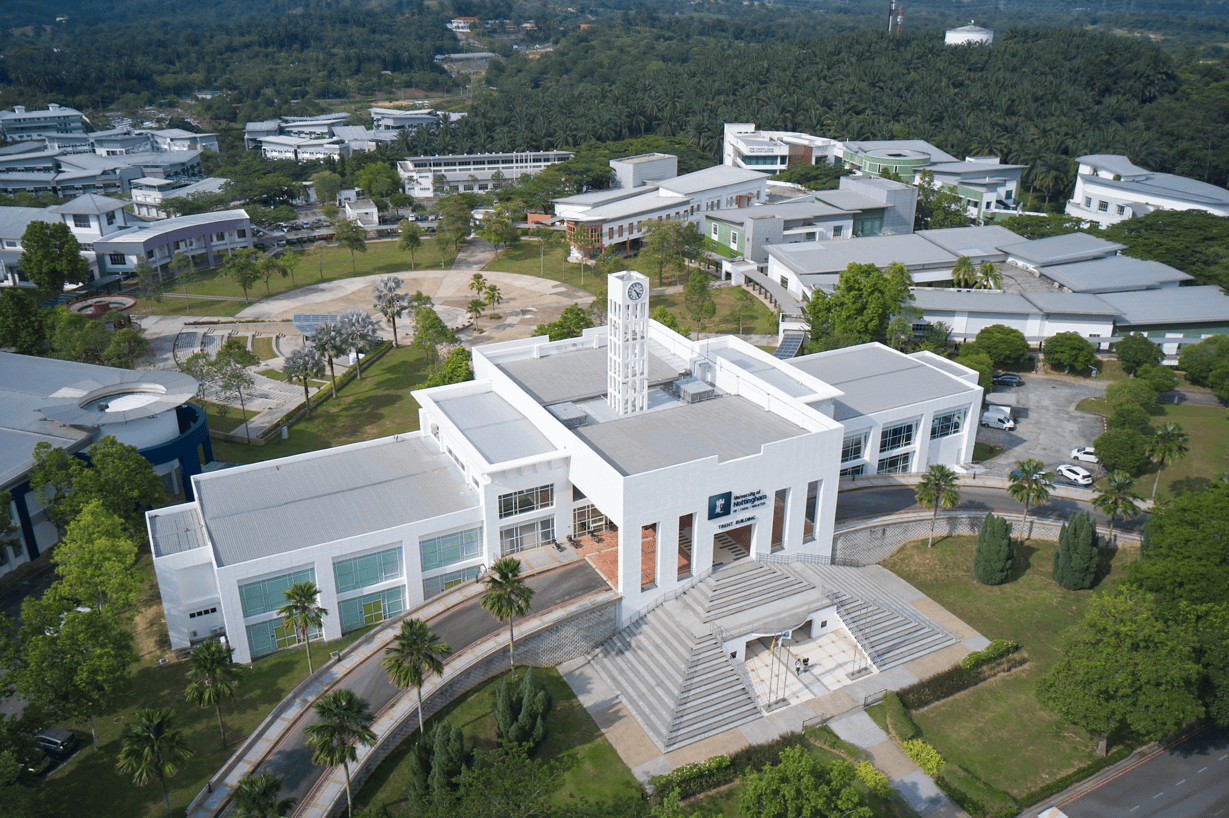
Branch campuses are also reshaping the picture. Students in Malaysia can earn a University of Nottingham or Monash degree for roughly half the cost of studying in the UK or Australia. The UAE and Singapore host multiple Western university campuses under the same model.
The Demographic and Economic Necessity Behind the Numbers
Several of these rising destinations are not just recruiting students out of opportunity. They are doing it out of necessity. International students are being increasingly seen as an essential part of a globally competitive higher education system, but also for economic vitality.
South Korea, Japan, Taiwan, and many European countries face serious birth rate crises. Taiwan's workforce grows at only 0.5% per decade and needs 320,000 international students by 2032 and has already moved its cohort share from 8% pre-pandemic to 18% today. Korea University established new scholarships targeting African, South American, and Eastern European students specifically to diversify its intake and prepare domestic graduates for global careers. The logic is straightforward: a more international campus produces better-prepared graduates.
Key Numbers to Know
- 8.5 million: Projected global international students by 2030 (QS)
- 423,000: International students in Germany in 2025
- 300,000: South Korea's international student target, reached two years early
- 230,000: International students in the UAE in 2025, up 90% in search interest
- 30-40%: Drop in US F-1 visa approvals for Indian and Nigerian students
- 139,341: International students in Malaysia in 2025, up 26% in applications
Looking Ahead
The international student market is not shrinking. It is shifting. Students who cannot access the US, UK, Canada, or Australia are finding quality alternatives across Europe, Asia, the Middle East, and Latin America.
The destinations growing fastest share a few things: affordable or free tuition, English-taught programs, post-study work rights, and government policies that actively welcome international students. Countries that removed barriers are getting the students that stricter destinations turned away.
Subscribe for the Next Analysis
Where are these 11 million students coming from? Subscribe to receive our next report analyzing the top source markets, emerging countries, and regional trends shaping global student mobility.
A Note on Data Integrity
In 2026, there is still no "universal" way to count a student between regions. Often how the official figures are reported tell as much about the strategy national interests, culture or goals as the numbers themselves. What counts as a student differs by country. Some differ on whether a short term language student is counted, such as a summer or exchange student, high school or university, or whether it only includes those on a specific type of student visa. Some countries also don't provide the same kind of data as others. These point deserves an article and report of its own.
Beyond the Headcount
In a world where productive output varies wildly between individuals, are total numbers even the most important metric? Focusing solely on volume ignores the "Quality vs. Quantity" debate. There is a vast economic and intellectual difference between a language student and a groundbreaking PhD candidate - yet in current global stats, they can carry equal weight (or the latter is counted multiple times across different stages).
A look at the top percentile of talent or the total market spend would show a very different picture of global influence. As would a study of how effectively that education works - how it trains, educates, produces impact, and integrates talent with global economic opportunity.
Grow and Diversify with Global Admissions
Global talent is moving beyond agent networks and is increasingly researching online.

Our AI-Agentic live platform connects global talent with the world's leading universities through AI discovery (Mimia) and online live events.
List and manage your programs, launch omni-channel digital marketing campaigns to grow your brand, fortify and future-proof your reach, and build a sustainable student pipeline.
Sources
This article draws on data from official government sources, international organizations, national statistical agencies, and reputable education news outlets. All figures represent the most recent reliable available data as of 2026.
- OECD Education at a Glance 2025
- IIE Project Atlas (Institute of International Education)
- Statista
- Eurostat
- QS Top Universities
- UNESCO Institute for Statistics
- University World News
- The PIE News
- ICEF Monitor
- EduRussia
- Open Doors - United States
- Immigration, Refugees and Citizenship Canada (IRCC)
- Ministry of Education of the People's Republic of China
- Australian Government Department of Education - International Education Data and Research
- Migration Observatory at the University of Oxford
- Higher Education Statistics Agency (HESA), United Kingdom
- UK Government Immigration Statistics
- Nuffic
- Statistics Poland (GUS)
- The Portugal News
- Campus France
- Czech Statistical Office
- MSM Unify
- BM.ge
- DAAD
- Anadolu Agency
- Nippon.com
- The Star (Malaysia)
- Business Times Singapore
- Study in Hong Kong
- Focus Taiwan
- Nhan Dan
- Thailand Government
- QazInform (Kazakhstan)
- Times of India
- Prague Process
- Slovak Spectator
- Bulgarian News Agency
- Macau Daily Times
- Saudi Gazette
- Morocco World News
- Petra News Agency
- State Information Agency of Azerbaijan
- Department of Higher Education and Training, South Africa
- Ghana Investment Promotion Centre (GIPC)
- Eastleigh Voice (Kenya)
- Tertiary Education Commission, Mauritius
- Education New Zealand (ENZ)
- Politis News Cyprus
- ECLBS Latvia
