
Reflecting on my career - I have been working in China for over 15 years in the education industry and have personally emailed or communicated with over 80,000 students looking to study in China. I have also visited over 100 Chinese universities such as Tsinghua, Wuhan, Fudan, and HKUST and CUHK and many more. I have also been founder of Beijing Edtech meetup group, and have a deep understanding of the Chinese outbound market by living in Beijing. I am familiar with the western and Chinese business models. This has given me a unique vantage point to understand the industry.
The History of the Industry
What is the education agent? I think it's a good idea to understand the history of the industry. The first education agents started in Australia in 1969 with IDP.
In 1990 with the economy opening up the self-funded study abroad booms in China birth of the modern commercial agency.
In the UK it happened much later In 1999, Tony Blair launched the Prime Minister’ Initiative (PMI). It set a target to recruit an additional 75,000 international students to the UK. UK universities realized they couldn't hit these targets with small, in-house teams. They began aggressively signing contracts with private agents in China, India, and Nigeria. In 2003, only about 10% of international students in the UK used agents; today, that number is over 50% (and up to 70-80% in markets like China).
For decades, the US higher education system viewed the "commission-based agent" as fundamentally unethical and banned it. When they finally lifted the ban in 2013, the floodgates opened.
This marks the first parts of the industry. Now we are in a maturing phase.
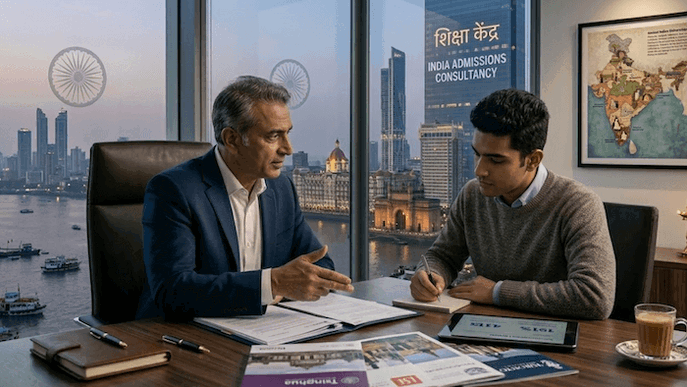
There are massive differences between markets - the majority of agents and students come from large markets such as China where they don't speak English. Agents role is an advisor, curator of information, and translator, reassurer, and service provider.
However in markets where the language is not English, or more culturally similar to English such as Europe or Africa (where they speak a European language), I see the role of the agent as being fundamentally different.
There is less of an information gap, and fewer barriers to studying abroad. With the rise of the internet, students are more likely to research and apply by themselves. The "DIY" (Do It Yourself) segment is the fastest-growing part of the market, but it is creating a "Bifurcation" rather than a total replacement of agents.
How AI is impacting the Student Recruitment Industry?
2005 (The Service Era): Value was in Access. "The agent has the information and university's contact and relationship"
2015 (The Portal Era): Value was in Efficiency. "I can research and submit 10 applications with one click."
2026 (The AI Era): This is currently playing out now.
Now we have the start of AI which acts as an advisor to students, I see this trend accelerating. Universities can accept more direct applications. I see the role of the education agent as declining in markets such as China where the numbers of students looking to study abroad is declining and more are choosing to study closer to home such as in Hong Kong and Macau.
The Weaknesses of the Traditional Student Recruitment Agent
1) It is heavily concentrated on certain markets such as China which reduces diversity of student body. Those in LIthuania, Panama and ROmania are not large enough for education agents and so do not get targeted. Universities focus more on those large markets such as China which yield high volume (because it is more efficient) which reduces diversity.
2) It can leads to suboptimum outcomes for students. For market such as UK, Australia and Canada, where there are relatively few universities and it is easier for agents to learn about all of them, there is less of a problem, but there is still an incentive of sending more students to a certain university which might not be in the best interest of the students. I know of one students in China who wanted to study in Canada, but their agent persuaded them to study in Australia. This changed their life trajectory through factors they were not aware about.
3) It is economically inefficient - universities are paying many millions to education agents, who are also receiving fees from students too. There is a race to the bottom where universities are incentivised to pay more of their fees to agents to attract more. Could a direct method work more efficiently?
4) It incentises unhealthy behaviour and lowers quality of students - agents are incentivised by volume of students over the quality of students. The result is that those top students are overlooked as they usually explore by themselves or are overlooked. Those who are more dependent will follow and apply with agents.
There are two key stages that are happening with AI that changes the market:
Why AI changes the market
1) Students can have access to much better information
2) The admissions process and follow ups can be automated.
The education agent model has reached it's peak and we are in the latter stages. I don't see it as going away and believe it will continue in the existing markets, but there will be, and is a rise of a new model that will operate at the same time.
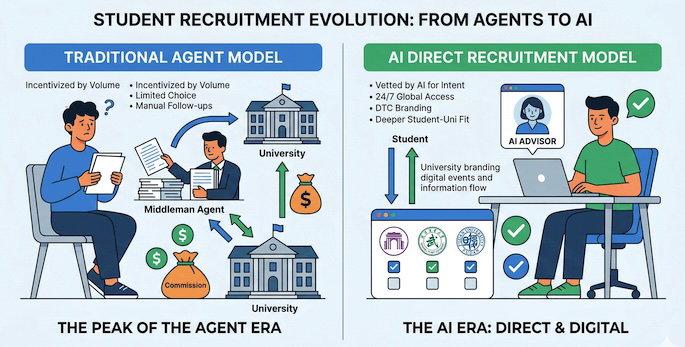
The Direct - Digital Recruitment Model
This hedges the risks and solves the problems of the education agent model. It reduces reliance on large markets, increases choice, and also competes with the agent model. It lowers cost, and builds brand value over time.
The new model is for universities to explore direct to consumer models by developing digital brands, online events, simplifying the information and automating the admissions process. Here are what I'm seeing as the future.
Direct-to-Consumer (DTC) Brands: Universities are moving to own their brand. By building strong digital brands and hosting online-first events, they are bypassing the "Agent Filter" and speaking directly to the students I’ve seen looking for genuine connection.
AI-Led Advisory: Instead of a human agent incentivized by commission, students now have access to "AI Counselors" (like Mimia). These tools don't sleep, they don't have "preferred contracts," and they prioritize Student-University Fit over a payout.
Automated Admissions: The future of admissions is more automated with AI follow ups and human in the loop, which reduces the cost of agents.
That is what we are building at Global Admissions.
Our AI-Agentic live platform connects the world's leading universities with the global talent through AI discovery (Mimia) and online live events.
List and manage your programs, launch omni-channel digital marketing campaigns to grow your brand, fortify and future-proof your reach, and build a sustainable diverse direct student pipeline.
