

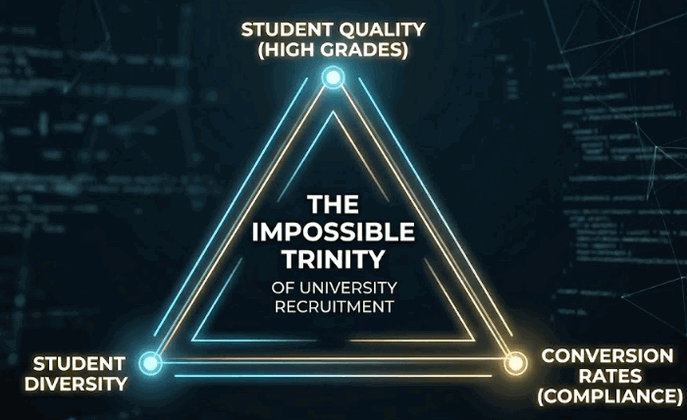
Universities around the world face an impossible problem. They are seemingly pulled in three different directions with competing goals and faced to make a choice.
On the one hand it's essential to increase the diversity of the student body. Diversity is valuable for a better student experience, and to meet EDI goals, but also decreases risk of overreliance on one or a few markets.
Quality of students in terms of grades, is essential for rankings and student experience.
Conversion Rates are essential for compliance and are often tied to quality but are something different. In some markets there are required conversion metrics.
But meeting all three is seemingly impossible with the current agent-led recuitment market.
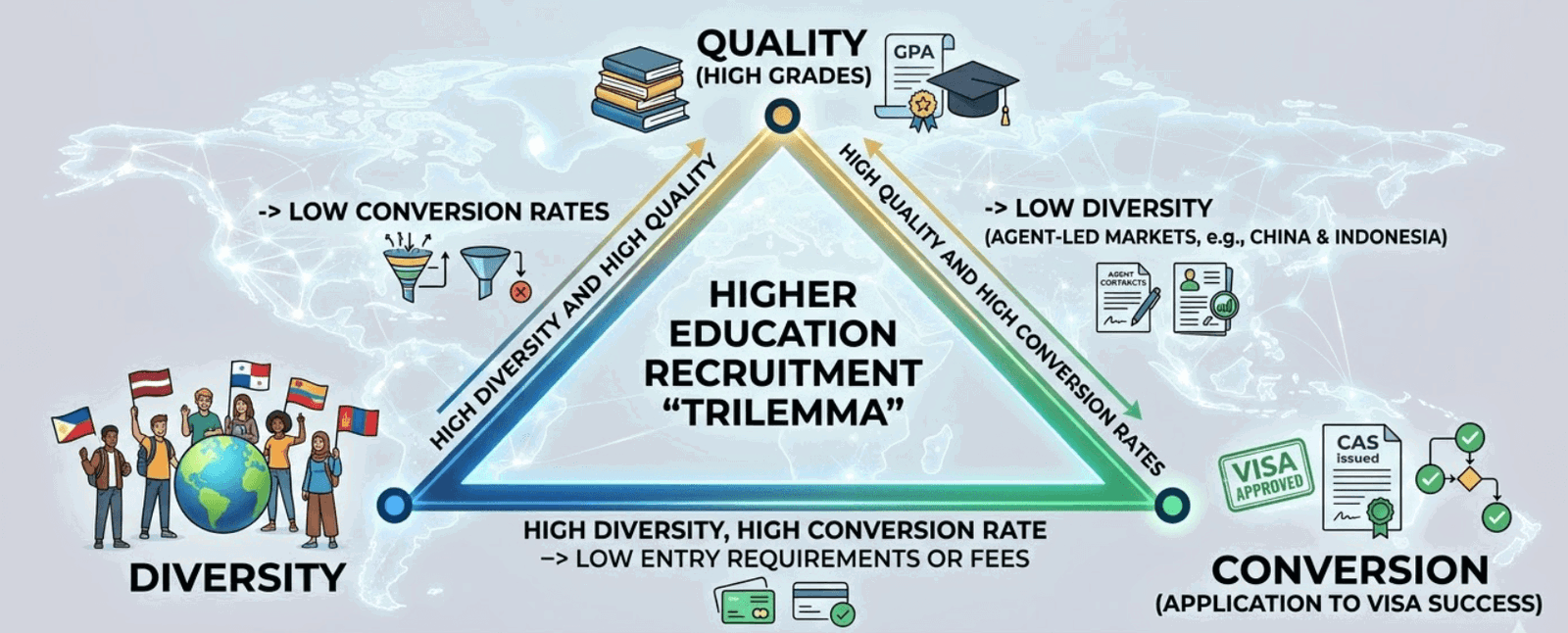
With increasing compliance and conversion requirements, it is rational to focus established agents in large markets, but that is at the expense of diversity. Universities become increasingly reliant on large markets that are non-English speakers because that is the only ones where there are large numbers of agents. China and Indonesia are two such as examples. However this is risky - relying on fewer markets increases overrelianace and risk of changing policies or priorities in that market.
The traditional agent-led student recruitment market doesn't solve the impossible trilemma because of this. Top students in smaller markets like Latvia and Panama and Mongolia (who are the growign and underserved market), lose out, and so does the university.
The solution, and hedge, is to focus on brand and digital marketing. Global Admissions is one such example of a platform that works with universities to develop their international brand, attract more high quality students, and encourage direct applications.
It's incredibly difficult because the admissions process is so long. Each cycle is 1 year, which gives very little time to experiment and try different strategies.
In order to break the Impossible Trinity we can still focus on using agents in those established markets but develop digital marketing and admissions solves these problems:
Pillar 1: Positioning
Many universities are having challenges because they are not differentiated. There are three types of universities that are clearly differentiated: 1) Top Ranked, 2) Specailised or Niche, 3) Anchor institutions connected to the labour market. The big university for everything model is struggling unless it connects well and has some clear routes to the labour market. Clear brand positioning into and differentiation helps to open up the digital market and allows a "Direct-to-Consumer" (DTC) relationship. When a university has a strong global identity, and clear differentiated brand they no longer need an agent to "sell" them to a student in a remote market. The student finds them directly, which immediately increases the Quality of the applicant (those who self-select for a brand are usually more motivated).
Pillar 2: The Internet as the "Diverse Option"
Digital content is the only recruitment tool that scales with zero marginal cost. It allows universities to be "omnipresent" and is naturally diverse. A well-placed digital campaign can find the three best students in Panama as easily as in Kazakhstan. This is how you achieve Diversity without the overhead of 100 global offices.
Pillar 3: Branding and AI as the Conversion Anchor
Branding and positioning helps with conversions. It has been proven to increase the pull and conversion rates further down the admissions process. AI automation also does too.AI breaks this by:
Integrity at Scale: Automating the "Trust" layer (interviews and verification) so the university can accept diverse students without fearing a visa refusal that would trigger a "Red" RAG status.
Frictionless Onboarding: Keeping the long-cycle student engaged with 24/7 personalized support, preventing "melt" before September.
