


If you're looking for an affordable European education with programs taught in English, a clear immigration pathway, and a growing tech industry, Lithuania should be on your list.
It's one of the three Baltic states in Northern Europe, a member of the EU and the Schengen Area, and it has been building a strong reputation as a serious study abroad destination over the past decade.
Why Study in Lithuania?
What makes Lithuania different from the more popular destinations like the UK, Australia, or Canada is the cost. You can save up to 80% on tuition compared to those countries, and your degree still carries international recognition. For medical and nursing students, that's a significant factor, because Lithuanian medical certificates are accepted across the EU without additional recognition, and graduates heading to the US or Australia only need to pass a couple of exams to practice there.
On top of that, Lithuania is one of Europe's fastest-growing tech hubs. Companies like Revolut (which got its EU banking license in Lithuania) and Binance have a major presence here, alongside a growing laser technology and semiconductor industry. If you're studying business, IT, or finance, the career opportunities after graduation are real and growing.

Lithuania is one of the rising destinations for international students
Best Cities to Study in Lithuania
Lithuania has three main cities where international students tend to concentrate, each with a different feel and set of universities.
Vilnius
Vilnius is the capital and the largest city, with a population of around 600,000. It's where most of the country's international business, tech companies, and government institutions are based. The Old Town is a UNESCO World Heritage Site, and the city has a mix of historic architecture and a modern startup culture. For students interested in business, IT, or social sciences, Vilnius offers the strongest career network and the most English-friendly environment in the country.
- Vilnius University, one of the oldest universities in Northern Europe, with over 20,000 students and a QS ranking around 450
- Vilnius Gediminas Technical University (VILNIUS TECH), strong in engineering, architecture, and IT
- Mykolas Romeris University, known for law, public policy, and social sciences
Kaunas

Kaunas, Lithuania
Kaunas is Lithuania's second-largest city and its academic center. It has a strong student culture, lower living costs than Vilnius, and a reputation for medical and health science education. The city was a European Capital of Culture in 2022, and it has a lively arts and food scene that makes it popular with younger students who want a more affordable, community-oriented experience.
- Vytautas Magnus University (VMU), one of Lithuania's top-ranked universities with a wide range of English-taught programs
- Lithuanian University of Health Sciences (LSMU), one of the top choices for medicine, dentistry, nursing, and veterinary science in the Baltics
- Kaunas University of Technology (KTU), a leading institution for engineering, technology, and applied sciences
Klaipeda
Klaipeda is Lithuania's third-largest city and its only port city, located on the Baltic Sea coast. It's smaller and more relaxed than Vilnius or Kaunas, and it's a good fit for students interested in marine sciences, logistics, or anyone who wants a quieter study environment with access to nature. Tuition here tends to be on the lower end, with some business programs starting at around €3,500/year.
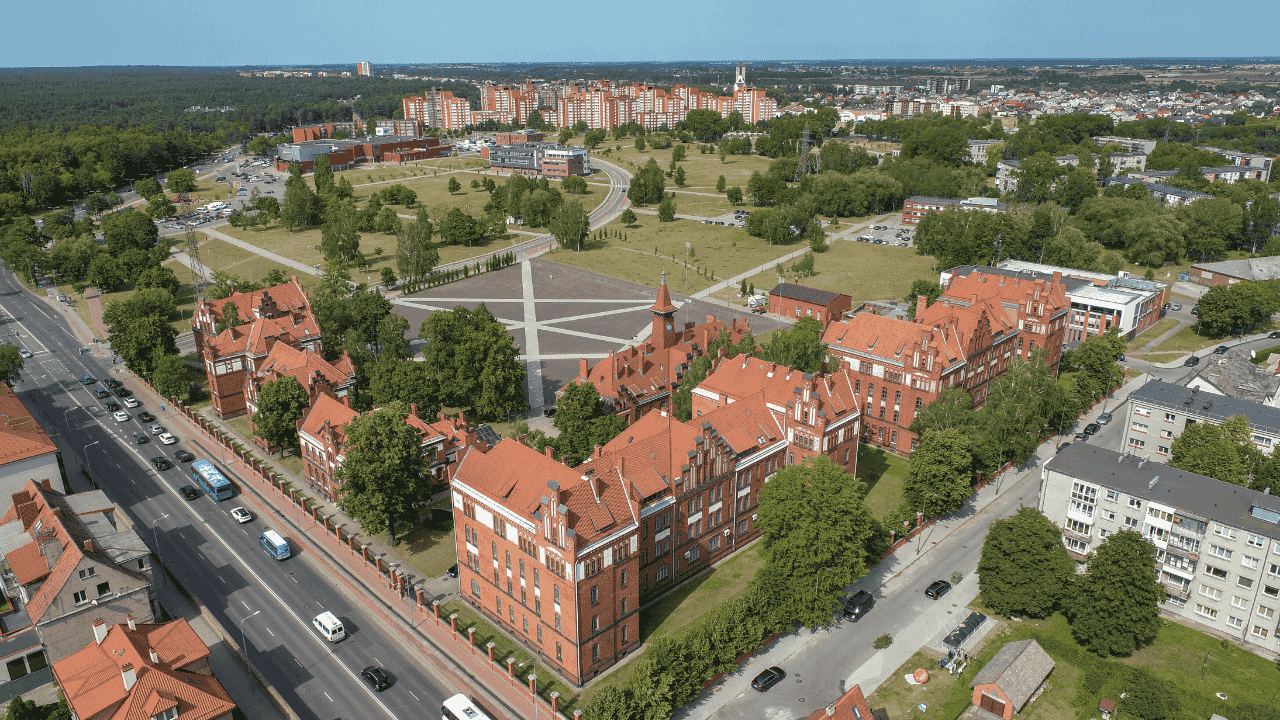
Klaipeda University, known for marine sciences, business administration, and health sciences
What are the Application Fees to Study in Lithuania?
One of the biggest draws of Lithuania is how affordable it is compared to Western Europe, the US, the UK, and Australia. Here's what you can expect to pay per year as an international student, depending on your field of study:
- Business and IT: €3,500 to €5,000/year
- Engineering and Technology: €4,000 to €6,000/year
- Nursing: starting around €6,000/year
- Dentistry and General Medicine: starting around €13,000/year
To put that in context, a comparable medical degree in the UK or Australia would cost you €30,000 to €60,000/year. Even at €13,000/year, Lithuania's medical programs represent a savings of 50% to 80%, and the degree is recognized across the EU, with a relatively simple recognition process in the US and Australia.
Cost of Living
Lithuania is one of the more affordable countries in the EU for daily expenses. Monthly costs for a student will vary depending on the city, but here's a general range:
- Accommodation (shared apartment or dorm): €200 to €450/month
- Food and groceries: €150 to €250/month
- Transportation: €20 to €30/month (student discounts available)
- Health insurance: approximately €50 to €100/month
- Total estimated monthly cost: €500 to €800/month
Compared to cities like London, Sydney, or even Warsaw, Lithuania's cost of living is notably lower, which means your budget stretches further while you study.
Top Universities in Lithuania
Lithuania has a mix of legacy universities and specialized institutions. One of the highest-ranked universities is Vilnius University sitting around the 450 mark in the QS World University Rankings.
| Ranking (in Lithuania) | Universities |
| 1 | Vilnius University |
| 2 | Kaunas University of Technology |
| 3 | Vytautas Magnus University |
| 4 | VILNIUS TECH (Vilnius Gediminas Technical University) |
| 5 | Mykolas Romeris University |
Popular Programs for International Students
The programs drawing the most international students to Lithuania fall into a few categories. Medicine and nursing are the biggest, especially among students from the US and UK who want to save on tuition while earning a globally recognized degree. Business and IT programs attract students from Africa, South America, and Southeast Asia, often at tuition rates under €5,000/year. And engineering programs at KTU and VILNIUS TECH have been growing in popularity, particularly in areas connected to Lithuania's semiconductor and laser technology industries.
Some of the most popular English-taught programs include:
- Medicine (6-year program)
- Dentistry (5-year program)
- Nursing (3.5 to 4-year program)
- Business Administration and Management
- Information Technology and Software Engineering
- Financial Technology (FinTech)
- Mechanical and Industrial Engineering
- Political Science and International Relations
English Language Requirements
Most English-taught programs in Lithuania require an IELTS score of 6.5 or equivalent. However, there are a few things that make this less of a barrier than in other countries.
First, the majority of Lithuanian universities accept a Medium of Instruction (MOI) certificate. If your previous schooling was taught in English, you can submit this certificate instead of taking a standardized test, which saves you both time and money. Second, Lithuanian universities also accept the Duolingo English Test, which is significantly cheaper and more accessible than IELTS or PTE. This is worth knowing if budget and test center access are concerns for you.
For programs like nursing, where hospital practice requires interaction with local patients, universities typically include Lithuanian language training as part of the curriculum, so you'll be supported in picking up the language as you study.
As for daily life, young people in Lithuania speak fluent English, and you can comfortably navigate hospitality, corporate environments, and social life in English without any Lithuanian at all.
Application Documents for Bachelor's Programs
- Completed high school diploma or equivalent
- Academic transcripts
- Passport copy
- English proficiency certificate (IELTS 6.5, Duolingo, or MOI certificate)
- Motivation letter or personal statement
- CV (some programs)
Application Documents for Master's Programs
- Bachelor's degree diploma and transcripts
- Passport copy
- English proficiency certificate
- Motivation letter
- CV
- Letters of recommendation (some programs require 1 to 2)
Application Deadlines
Most Lithuanian universities follow a two-intake system:
- Fall intake (September start): applications typically open January to June
- Spring intake (February start): applications typically open September to December (available at select universities)
It's a good idea to apply early, especially for popular programs in medicine and nursing, as spots can fill up quickly.
You can browse programs in Lithuania here.
Scholarships
Lithuania offers a few scholarship options for international students, though the landscape isn't as large as in countries like Germany or the Nordics. The main options to look into include:
- Lithuanian Government Scholarships: available for students from select developing countries, covering tuition and sometimes a living stipend
- University-specific scholarships: many universities offer merit-based tuition reductions for high-performing students, particularly at the Master's and PhD level
- Erasmus+ funding: if you're an EU student or coming through a partner university, Erasmus+ exchange funding can cover a semester or year in Lithuania
- External scholarships: organizations like the Visegrad Fund and various bilateral agreements between Lithuania and other countries also offer funding options
Because tuition in Lithuania is already low compared to other European and English-speaking destinations, even without a scholarship, the overall cost of your education will be significantly lower than in the US, UK, or Australia.
Work Opportunities and Permanent Residency
This is one of the areas where Lithuania stands out compared to many other study destinations. The pathway from student visa to permanent residency is clear, achievable, and doesn't come with the kind of uncertainty students face in countries like Australia or Canada.
Working While You Study
As an international student in Lithuania, you can work part-time during your studies. Many students pick up work in hospitality, tech companies, and customer service, particularly in Vilnius where English-speaking roles are common.
Permanent Residency (PR) After Graduation
If you hold a temporary residence permit (student visa) for 5 consecutive years in Lithuania, you can apply for permanent residency. That means if you study a 4-year Bachelor's degree and then work for one year, or complete both a Bachelor's and Master's degree, you meet the time requirement. The process involves passing a basic Lithuanian language exam, but there are no massive hurdles beyond that.
Compare that to Australia, where even after completing a Bachelor's and Master's degree, permanent residency is not guaranteed because of high benchmarks for skilled visas. In Lithuania, the pathway is predictable.
Fast-Track PR for Highly Skilled Workers
If you find a job in Lithuania after graduation and your occupation is on the skilled list (IT, medicine, engineering, or a company director/general manager position), you can fast-track your permanent residency to 3 years instead of 5. This is a significant advantage for graduates in high-demand fields like tech, healthcare, and finance.
Residency by Investment
For those interested in entrepreneurship, Lithuania also offers a residency-by-investment route. If you invest €28,000 in a startup in Lithuania, you can receive a temporary residency permit for up to 5 years. If you become a company director, you can fast-track your permanent residency to 3 years. You do need to spend approximately 90% of your time in Lithuania to qualify, but since Lithuania is in the Schengen zone, you have free access to travel across 27 European countries while maintaining your residency.
How Lithuania Compares to Other Study Destinations
If you're considering multiple countries, here's how Lithuania stacks up against some of the more popular alternatives.
Lithuania vs. Australia and the UK
The savings are the most obvious difference. Tuition in Lithuania is 50% to 80% lower, and cost of living is roughly half of what you'd spend in London or Sydney. The PR pathway in Lithuania is also more straightforward than in Australia, where immigration policy changes frequently and skilled visa benchmarks can be difficult to meet.
Lithuania vs. Poland and Latvia
Poland and Latvia have been popular alternatives in the Baltics and Central Europe, but both countries have recently introduced strict immigration policies in response to a sudden influx of international students. Visa refusal rates in Poland and Latvia are currently high. Lithuania's government has managed the growth in international students more carefully, and while visa refusals do happen, the rate is not as high as in neighboring countries. If you're applying to Poland or Latvia, it's worth having a backup application in Lithuania.
Lithuania vs. Germany and the Nordics
Germany and Norway offer zero or very low tuition, but the cost of living in those countries is significantly higher. Lithuania's combined cost (tuition plus living expenses) often comes out comparable or lower. Lithuania also has a more accessible PR pathway, while Germany's post-study visa system requires finding a job within a specific timeframe and meeting income thresholds.
Lithuania's Growing Industries
Understanding where the job market is heading can help you choose the right program. Lithuania has become a recognized hub for several high-growth industries:
- FinTech: Lithuania issues more FinTech licenses than any other EU country, and Vilnius hosts regional offices for Revolut, Binance, and dozens of other financial technology companies
- Laser technology: Lithuanian companies produce a significant share of the world's scientific and industrial lasers
- Semiconductors: the country is building capacity in chip manufacturing and related engineering fields
- Life sciences and biotech: growing investment in pharmaceutical research and biomedical engineering, particularly in Kaunas
If you're studying IT, finance, engineering, or health sciences, these industries represent real employment opportunities after graduation, not abstract possibilities.
What to Do Next
If Lithuania sounds like the right fit for your goals, here's how to move forward:
- Browse English-taught programs in Lithuania on Global Admissions to find the right university and course for your budget and career plans.
- Check admission requirements for your chosen program, including English language proof and any program-specific prerequisites.
- Start your application early, especially for medicine and nursing programs where spots fill up fast.
- If you have questions about visas, residency pathways, or the application process, book a call with us and we'll walk you through it.
Lithuania isn't the most well-known study abroad destination yet, but the students who do their research are finding that it offers a rare combination: affordable tuition, English-taught programs, globally recognized degrees, and one of the clearest pathways to permanent residency in Europe.

Continue reading:
