Maritime Transport
Riga Technical University
Riga, Latvia English
Next Start Date
Sep 2027
Duration
1 year
Yearly Tuition
7,138 USD
Riga, Latvia
Riga Technical University is Latvia's largest technical university, and the honest way to read its tuition page is: check the specific programme, not the average. Twenty-seven of the programmes in this catalogue have a verified price straight from RTU's own DreamApply application portal, and twenty-six of those run higher than what's listed here. That gap matters more than any acceptance-rate estimate would, because it changes what you actually need to budget.
Apply here if you want an English-taught technical degree in the EU at a price still well under Western European private tuition. Most Master's programmes run two intakes a year — Autumn from 1 September, Spring from late January — so a missed deadline in one cycle isn't a lost year. The clearest reason to pick RTU over a generalist university is its concentration in Engineering, Computer Systems, Cybersecurity and the Maritime Academy's specialist Bachelor's tracks: narrow, technical, and priced accordingly.
It's a weaker fit if you want a large published scholarship program beyond Latvia's national state scholarship, or a globally ranked brand name behind your degree. RTU's pitch is depth in Engineering, Computer Systems and maritime training, not a league-table position.
70
Programs
16 phd, 32 master, 22 bachelor
USD 5,384
Avg. Tuition / Year
The document set differs by level in a few places:
| Document | Bachelor's | Master's |
|---|---|---|
| Secondary certificate & transcript | Required | Not required |
| Undergraduate diploma & transcript | Not required | Required |
| Passport copy | Required | Required |
| English proficiency certificate | Required (waived if prior education was in English) | Required (same waiver) |
| Academic or personal reference (at least 1) | Required | Required (academic or professional) |
| Motivation letter | Required | Required |
| RTU entrance exam | Required (online maths test, all sampled programmes) | Programme-specific (e.g. Computer Systems MSc) |
Deadlines and start dates also differ by level and, for at least one programme, by citizenship:
| Level / programme | Opens | Early deadline | Regular deadline | Notification | Semester start |
|---|---|---|---|---|---|
| Bachelor's (2027 intake, all catalogued programmes) | – | – | 1 July 2027 | – | 1 September 2027 |
| Master's (2027 intake, all catalogued programmes) | – | – | 1 July 2027 | – | 1 September 2027 |
| Executive MBA (non-EU/EEA applicants, 2026 intake) | 1 February 2026 | 1 March – 8 May 2026 (Early Bird) | 1 August 2026 | mid-August 2026 | September 2026 |
Deadlines render per-applicant on apply.rtu.lv through a citizenship selector rather than as one fixed date on the public course page — check the portal directly under your own citizenship rather than relying on a single published date. RTU runs an Autumn intake starting 1 September and, for most Master's programmes sampled, a Spring intake that most recently started 26 January 2026 — so a missed Autumn deadline is not automatically a lost year.
Every Bachelor's programme we checked — Civil Engineering, Computer Systems, Environmental Engineering, Materials Engineering, Mechanical Engineering, Smart Electronic Systems and Telecommunication Technologies among them — requires the identical 10-question online maths exam, so Bachelor's applicants are preparing for one predictable target regardless of programme, followed by the self-scheduled interview.
Master's-level testing is programme-specific rather than universal. MSc Computer Systems requires a timed online subject exam in 5 sections — Mathematics, Algorithmizing, Data Structures, Programming and Databases, 45 minutes each — on top of the interview. Business Finance, Entrepreneurship and Management, and Logistics and Supply Chain Management show only the interview and reference/motivation-letter requirements on their own course pages, with no separate subject exam mentioned. Because the maths exam covers general secondary-level material rather than programme-specific content, the most useful preparation is a broad refresh of core algebra, geometry and functions rather than material tailored to your intended engineering discipline.
Budget for three separate charges, not one: the EUR 150 application fee, the EUR 250 deposit, and first-year tuition itself — all confirmed as distinct line items across every programme we sampled.
Doctoral admission runs through a separate channel from apply.rtu.lv, which covers every Bachelor's, Master's, Executive and short-course programme at RTU but carries no Doctoral category in its own type filter. Prospective PhD applicants should go directly to RTU's international admissions office for current Doctoral School procedures and fees.
The clearest strategic point in RTU's own account of the process is that the university runs one predictable admissions mechanic across a wide programme list, rather than a bespoke process per faculty: the same DreamApply portal, the same EUR 150 fee, the same EUR 250 deposit, and the same core document set for every Bachelor's or Master's applicant, with the entrance testing as the only major point of variation between programmes.
Before you submit
Get your Riga Technical University application checked by an advisor
One missed document can cost you a whole intake. Spend 30 minutes with an advisor who has taken students through this exact application, and leave knowing what to submit , and what has to happen before 1 July 2027.
30 minutes · one-to-one
| Level | Tuition (EUR/year) | Basis |
|---|---|---|
| Bachelor's | 3,550 – 6,800 | Verified sample of 11 programmes, RTU's own application portal |
| Master's | 3,500 – 5,890 | Verified sample of 16 programmes, RTU's own application portal |
| PhD | 3,610.72 – 15,165.00 | Catalogue-listed range, 16 programmes, median EUR 8,820.46 |
| Application fee | 150 (flat, one-time) | Identical across every sampled programme |
| Deposit | 250 (one-time) | Separate from tuition and the application fee |
Twenty-seven of RTU's catalogued programmes have a price we checked one-by-one against apply.rtu.lv, RTU's own application portal — the university's DreamApply pages, not a third party. Twenty-six of those run higher than this catalogue's own listed figure, by roughly EUR 400 to 1,900 a year; only Civil Engineering runs the other way, listed here at EUR 4,539.19 against RTU's own published EUR 3,720. Last verified 20 July 2026.
Two catalogued programmes — Medical Engineering and Physics (Bachelor's) and Design Engineering (Master's) — are live on apply.rtu.lv without a published tuition figure on their own course page; confirm pricing directly with RTU before budgeting for either.
Latvia's national study-abroad agency puts Engineering tuition nationally at roughly EUR 2,700–3,500 a year and Computer Science at EUR 1,800–3,800, against a national ceiling near EUR 15,000–25,600 for the country's most expensive programmes. RTU's own verified Computer Science-adjacent fees — EUR 4,700 at Bachelor's, EUR 5,590 at Master's — sit above that national engineering and computing band. At the extremes, the same national data puts the cheapest Latvian Bachelor's programmes under EUR 1,600 a year, against EUR 15,000 for Dentistry and EUR 25,600 for an Executive MBA elsewhere in the country — a reminder that "Latvia" is not one price point, and RTU's technical programmes sit in the upper-middle of that national spread. The EUR 150 application fee sits exactly at Latvia's typical national benchmark.
| Scheme | Eligible | Amount | Deadline |
|---|---|---|---|
| Latvian State Scholarship | Citizens of roughly 40 countries with a bilateral education/science agreement with Latvia, including China, Georgia, Kazakhstan, South Korea, Ukraine, USA, Uzbekistan and Vietnam. Master's and PhD applicants qualify from any prior institution; Bachelor's applicants must already have completed at least 1 academic year of higher education. | EUR 500/month (Bachelor's/Master's) or EUR 700/month (PhD), for up to 10–11 months, renewable for a maximum of 2 terms within one study cycle | Bachelor's-track applications fall in February–March of the intake year |
The Latvian State Scholarship is a national scheme run by Latvia's Ministry of Education and Science and VIAA, not an RTU-specific award, so the country-eligibility gate above applies before anything else does. It doesn't cover tuition, living costs or travel in full, can't be combined with other grants, requires you to arrange your own insurance, and isn't paid if you spend fewer than 15 calendar days in Latvia during the award period. The eligibility gate is about citizenship, not merit: Master's and PhD applicants qualify from any prior institution, while Bachelor's applicants need at least a year of higher education already under their belt before they can apply at all.
You apply for it through RTU's own portal, not separately: select it as a second, mandatory option alongside your chosen programme on apply.rtu.lv, upload your qualification documents, English proficiency proof, passport and a Europass-format CV, and pay the application fee. Once your invoice is marked paid, RTU invites a pre-recorded video interview and confirms your other programme-specific requirements, then issues the scholarship documentation within about 5 business days after your interview (and any required maths test) are complete. Keep that documentation with your acceptance letter — the same paperwork trail supports your residence-permit application afterwards.
If your country doesn't hold a bilateral agreement with Latvia, this scheme simply won't apply to you, so the safer planning assumption is to budget the full, verified tuition, deposit and application fee for your chosen programme rather than count on a discount arriving later.
| Language of instruction | Bachelor's | Master's | PhD | Total |
|---|---|---|---|---|
| English | 22 | 32 | 16 | 70 |
All 70 of RTU's catalogued programmes teach in English, spanning 19 disciplines led by Engineering (19 programmes), Management (6), Chemistry (4), and Civil Engineering, Computer Engineering, Electrical Engineering and Business (3 each). RTU's own portal markets this as over 50 English-taught programmes site-wide across IT, civil and mechanical engineering, natural sciences, environmental and maritime engineering, entrepreneurship and educational sciences.
The clearest flagship offer is the RTU Latvian Maritime Academy's three Bachelor's tracks — Maritime Transport – Navigation, Marine Engineering, and Marine Electrical Automation — priced above every other Bachelor's programme we verified and genuinely distinctive against a typical technical-university lineup. For tech applicants, MSc Cybersecurity Engineering and MSc Computer Systems are the two most relevant Master's routes. The catalogue's single highest-listed tuition is the PhD in Architecture, at EUR 15,165/year.
RTU's own portal also lists programmes not yet in this catalogue: Finance Management Information Systems (Bachelor's), Architecture (Master's), Educational Sciences (Master's), Laser Technologies (Master's), and two English Foundation pathway options for students who want to raise their language level before starting a full degree — a Foundation Semester at EUR 2,500 and a Foundation Year at EUR 3,500. Either Foundation option is worth checking before you assume you don't meet the English threshold for your intended degree; it's a paid bridge rather than a rejection.
Engineering is the single largest discipline in the catalogue at 19 programmes, ahead of Management (6) and Chemistry (4) — the clearest signal of where RTU concentrates its English-taught teaching capacity, spread across the Bachelor's, Master's and PhD tiers rather than any one level alone.
Riga Technical University
Riga Technical University
Riga Technical University
Riga Technical University
Riga Technical University
Riga Technical University
Riga Technical University
Riga Technical University
Riga Technical University
Riga Technical University
Riga Technical University
Riga Technical University
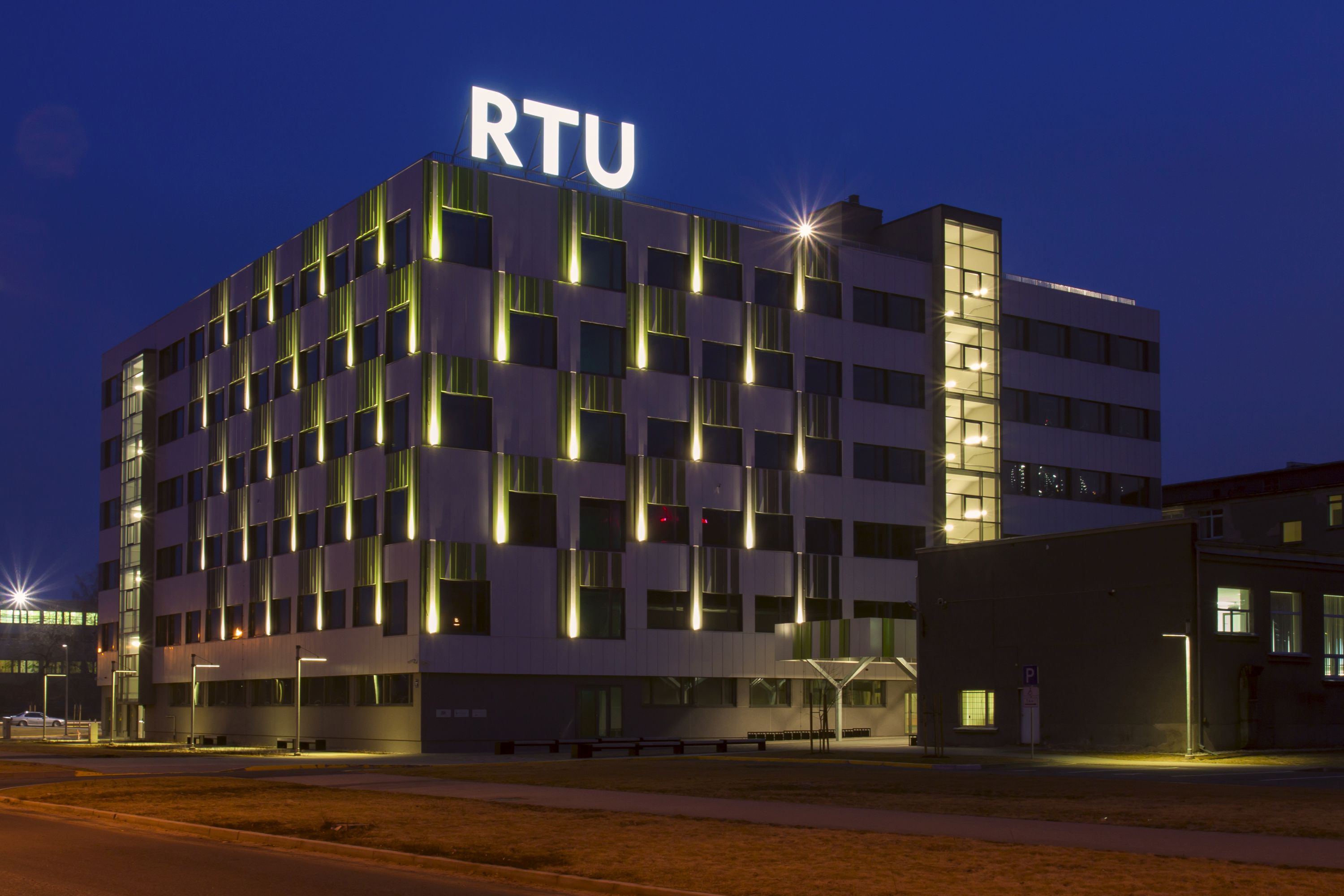
Riga Technical University, founded in 1862, is Latvia's oldest and largest technical university. It counts over 19,000 students in total, including roughly 3,000 international students; its own admissions portal separately markets "a vibrant student community of over 13,000 students." The main campus sits on Kipsala, an island in central Riga, with a second RTU campus in the coastal city of Liepaja on Latvia's western shore.
RTU also absorbed the former Latvian Maritime Academy, which is why its maritime Bachelor's programmes — Navigation, Marine Engineering and Marine Electrical Automation — run through the same DreamApply admissions system as the rest of the university rather than a separate one.
Latvia's national study-abroad agency positions Riga as the country's main student hub, home to the majority of Latvia's higher education institutions. The city's Old Town is a UNESCO World Heritage Site, and Riga holds one of Europe's largest collections of Art Nouveau architecture — a genuine backdrop rather than a marketing line, since it's the national tourism authority's own framing of the city, not RTU's.
Engineering accounts for 19 of RTU's 70 English-taught programmes, followed by Management (6) and Chemistry (4) — a lineup concentrated in technical fields rather than spread across a broad liberal-arts catalogue.
Graduates who secure employment in Latvia can move from a study-based residence permit to a work-based one through the same national authority, Latvia's Office of Citizenship and Migration Affairs (OCMA), that manages the original student permit application — a continuous route from classroom to workplace rather than a separate visa process.
EU, EEA and Swiss citizens don't need to register with Latvia's migration authority (OCMA) for stays under a year at a registered institution like RTU — a valid passport or ID card is enough to enter and start studying, though a residence permit can still help with things like opening a bank account.
Non-EU nationals from visa-exempt countries can enter and stay up to 90 days in any 180-day period without a visa, but full-time study beyond 90 days requires a residence permit; part-time study first requires holding a valid residence permit in another Schengen country.
For the residence-permit route, OCMA requires proof of at least EUR 620 a month in subsistence funds for the applicant, plus EUR 620 a month for each accompanying adult family member and EUR 150 a month per accompanying minor child. The application itself needs a full passport copy, a completed application form, a photograph, a certificate of no criminal record (if you've lived over 12 months in your home country and are over 14), the subsistence-proof document, a state-duty payment confirmation, and a signed study agreement — RTU must first approve your invitation with OCMA before you apply.
Every applicant, regardless of citizenship, needs at least CEFR B2 language proficiency for an English-taught programme. Your foreign diploma or certificate also needs equivalence recognition from the Academic Information Centre of Latvia (AIC), the country's ENIC/NARIC office — a process that takes about a month, longer depending on your country of origin. In practice: RTU issues an invitation number, you gather your documents (requirements vary by nationality and study level), submit them at the Latvian embassy covering your country of residence, attend an embassy interview, and receive a decision. This sequence is fixed rather than flexible: OCMA has to approve RTU's invitation before you can lodge anything at an embassy, and the embassy interview is the final step before a decision, not an optional formality to skip if you're short on time.
Browse programs, compare universities, and start your application.
Applying to Riga Technical University?
Get your application reviewed 1:1
We use cookies to improve your experience and analyze traffic. Read our Cookie Policy .