
R 7617 Vedlejsi Menu Studium
Czech University of Life Sciences Prague
Prague, Czechia English
Yearly Tuition
1,600 USD
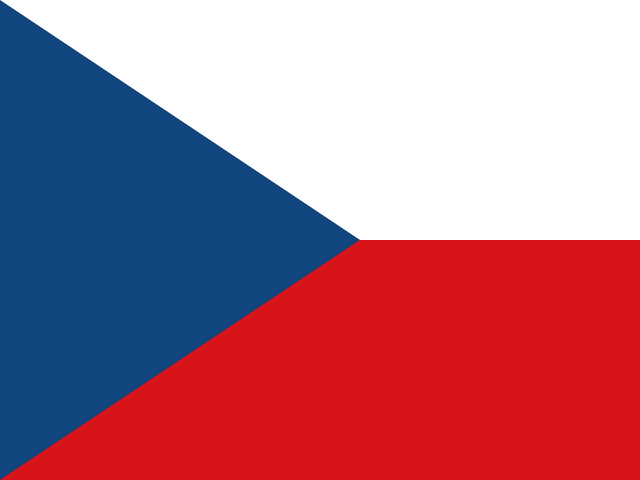
Czechia currently hosts over 52,000 international students in degree programs, making it one of the most popular educational hubs in Central Europe. You can choose from more than 1,000 accredited programs taught in English across the country. Eight Czech universities rank among the top 1,000 globally, with three appearing in the top 500 of the QS World University Rankings 2026.
This destination is ideal if you are looking for advanced degrees, as 82 of the 97 available programs are at the Master's or PhD level. You will thrive here if you specialize in technical or scientific fields like Chemistry, Information Theory, or Software Engineering. Students from outside the EU must apply for a student visa which costs CZK 2,500 at a Czech Embassy or Consulate.
Tuition fees vary significantly depending on your choice of institution, ranging from USD 1,289 to USD 36,970 per year. While the average tuition sits at USD 5,823, about 94% of English programs cost between EUR 0 and EUR 6,000 annually. Top institutions like Palacký University Olomouc and Masaryk University offer strong research prospects in English and Chemistry. If you study in the Czech language at a public university, your tuition is free of charge. You can Browse all 97 programs to find the right fit for your budget and career goals.
Czech University of Life Sciences Prague
Czech University of Life Sciences Prague
Czech University of Life Sciences Prague
Czech University of Life Sciences Prague
Czech University of Life Sciences Prague
Czech University of Life Sciences Prague
Czech University of Life Sciences Prague
Czech University of Life Sciences Prague
Czech University of Life Sciences Prague
Czech University of Life Sciences Prague
Czech University of Life Sciences Prague
Czech University of Life Sciences Prague
Your budget for studying in Czechia depends on your chosen program and lifestyle. With 97 programs available, you have several price points to consider. Tuition fees start as low as USD 1,289 per year. The average cost for international students is USD 5,823 per year. If you choose specialized fields, your costs could reach USD 36,970 annually. Action: Compare the 97 available programs to find a tuition rate that fits your financial plan.
Living costs in Czechia are lower than in many Western European countries. You should budget between USD 450 and USD 800 per month to cover your basic needs. This range includes your housing, food, and local travel. Renting a room in a university dormitory is your cheapest option. Dorms typically cost between USD 65 and USD 255 per month with utilities included. If you prefer a private flat, expect to pay between USD 85 and USD 680 monthly.
Your daily expenses like food and transport are manageable. Most students spend between USD 200 and USD 350 on groceries and dining each month. A simple meal at an affordable restaurant costs about USD 2. Monthly utilities for a private apartment usually range from USD 40 to USD 70. Action: Use these monthly estimates to create a personal spending spreadsheet before you apply.
Czechia is an affordable alternative to the UK or the US. For example, a three year engineering degree in Malaysia costs roughly USD 17,000 to USD 21,000. The same degree in the UK can cost up to USD 54,000. Studying in this region allows you to save between USD 25,000 and USD 32,000 in tuition fees alone. Action: Calculate your total savings by comparing Czechia tuition with your home country options.
While free tuition is not available for these specific programs, you can lower costs through university-specific aid. Public universities often have lower fees for masters degrees, starting near USD 515 per year in some cases. Private institutions may offer different rates starting at USD 1,350. Action: Check the specific scholarship page of your target university to see if you qualify for merit-based discounts.
Finding funding for your studies in Czechia requires looking at government programs and specific university funds. Most financial aid focuses on students from developing nations or those with high academic marks. You can find options ranging from monthly living stipends to one-time arrival grants.
Government & National ScholarshipsMasaryk University offers the Compatriots Scholarship for students who can prove Czech roots. This provides CZK 100,000 per year. If you choose Palacký University Olomouc, you can apply for faculty-specific merit awards once you complete your first semester with high marks. The University of New York in Prague offers early bird discounts and family discounts if a sibling also studies there.
Application TipsApplying to universities in Malaysia requires careful planning to meet specific institutional standards. You have 97 English-taught programs to choose from, including 15 Bachelor's, 48 Master's, and 34 PhD options. Top-ranked institutions like Universiti Teknologi Petronas, University of Malaya, and Sunway University lead the academic landscape.
Step 1: Meet Entry Requirements
Public universities accept international students with GCSEs and A levels or equivalent qualifications recognized by the Malaysian Qualifications Agency. Private universities often offer more flexibility for students with IGCSEs. If you apply for design or architecture, you must provide a portfolio. Postgraduate applicants typically need a resume or CV.
Step 2: Prove Your English Proficiency
Since most courses use English as the medium of instruction, you must submit test results. Accepted exams include IELTS or TOEFL. Malaysia ranks in the top three in Asia for English proficiency, and 72% of the population speaks conversational English, making it easy to communicate outside of class.
Step 3: Track Your Deadlines
Universities review applications over several weeks. You should apply early to secure your spot. Notable upcoming deadlines include:
Step 4: Gather Your Documents
You will need to upload these digital copies to portals like MAYA or TOPAS:
Step 5: Avoid Common Pitfalls
Applications are often rejected for missing documents or failing to pay the deposit after receiving an offer letter. Ensure all translations of transcripts are official. Once you accept an offer, you must apply for a student visa to enter the country. Malaysia aims to host 260,000 international students by 2030, so competition for spots at top universities is increasing.
Next Step: Search for your specific program on Global Admissions to view exact GPA and document requirements for your chosen university.
Choosing to study in Czechia means joining a community across 3 universities with 97 different programs. You will find that your budget goes further here than in most Western European destinations. Living costs average USD 582 per month, which is lower than the global average.
Housing OptionsYou have two main choices for where to live. On-campus dormitories are the most affordable, costing between USD 50 and USD 150 per month. These offer easy access to campus resources and a built-in social circle. If you prefer more privacy, off-campus shared apartments or private studios typically cost between USD 300 and USD 300 per month. Sharing a house with other students is a common way to reduce these rental costs.
Action: Contact your university housing office early to secure a dormitory spot as these fill up quickly.
Daily ExpensesYour monthly utility bills, including electricity, water, and garbage, usually range from USD 40 to USD 65. Staying connected is inexpensive. A mobile plan costs about USD 8 per month, while home internet is around USD 25. For food, you can find meals at local stalls for USD 1 to USD 3. If you eat at mid-range restaurants, expect to pay between USD 10 and USD 10 per meal. You can save 30% to 50% on food costs by cooking at home.
Action: Set up a local bank account upon arrival to manage your monthly utility payments easily.
Getting AroundYou do not need a car to live as a student here. Public transport is reliable and affordable. A monthly pass for a student using city transport like the LRT or MRT costs between USD 11 and USD 32. Many students use travel passes or discounted cards to keep these costs low. For late-night travel or long distances, ride-sharing apps are available.
Action: Apply for a student travel card immediately after enrollment to access discounted transit fares.
Climate and SafetyThe weather is tropical and warm year-round with no winter season. You should pack light, breathable clothing. The country is safe for international students and ranks 12th in Asia for quality of life. English is widely spoken, along with Malay and Mandarin, making it easy to navigate daily life and meet new people.
Action: Check the specific 97 programs available to see which city fits your lifestyle needs.
Your career in Czechia begins with a significant legal advantage. As a graduate of a Czech university, you have free access to the labor market. This means you do not need a work permit to start a job. To stay after graduation, you can apply for a nine month residence permit to search for a job or start a business. Once you secure a position, you will transition to an Employee Card or a Blue Card for highly skilled roles.
The job market is shaped by high demand in technical fields. Top disciplines with strong prospects include English, Chemistry, Information Theory, and Software Engineering. Data shows that software engineering and information theory are particularly lucrative as the country grows into a European tech hub.
Salary expectations vary by your chosen field. You can expect these typical annual ranges:
Major employers actively hiring international talent include global firms like Skoda Auto, Avast, Microsoft, and Infosys. The manufacturing and automotive sectors remain the largest employers, but the R&D sector is expanding quickly in cities like Prague and Brno.
You must be realistic about the challenges. While tech roles often use English, most local companies require Czech language proficiency for daily operations. Competition is high for entry level roles in non technical fields. You will need to prove your specific value to an employer early in your job search to stand out among local graduates.
Next step: Research specific degree programs in Software Engineering or Chemistry to align your studies with Czechia's highest growth industries.
To study in Malaysia, you must obtain a Student Pass. This is an official long term pass issued by the Malaysian Immigration Department for those enrolled in full time academic programs. You cannot enter as a tourist and then convert your status to a student once you arrive.
How to apply for your Student Pass:
Costs and Timeline:
The annual fee for the Student Pass is approximately MYR 60. In addition to this government fee, universities may charge their own processing fees. The application process usually takes between 14 and 30 days. You must renew your pass every year at least 45 days before it expires.
Work Rights during studies:
You can work part time for up to 20 hours per week during semester breaks or holidays of more than seven days. You must get prior approval to work. This pass also allows your spouse or children to apply for a Dependent Pass if you are enrolled in a postgraduate program.
Next Step: Contact your chosen university's international office to begin your application for the Visa Approval Letter (VAL) at least three months before your course starts.
Browse programs, compare universities, and start your application.
We use cookies to improve your experience and analyze traffic. Read our Cookie Policy .