
Study medicine abroad
MBBS Abroad: The Definitive Guide
MBBS abroad means studying medicine outside your home country, usually because a seat at home is unaffordable or hard to win. This guide compares 12 countries and 231 verified programs: real fees, real entrance rules, and the one thing most guides skip — whether the degree lets you practice when you come home.
- Every fee and entrance fact on this page is sourced — or left out.
- A foreign degree never licenses you at home by itself. Every country adds its own exam or registration step after graduation, so it needs planning from day one.
- Not sure where you fit? The 1-minute checker below gives you a shortlist.
Which country?
Every country here has verified programs listed on Global Admissions. You're looking at the cheapest sourced tuition, how long the degree runs, and how you get in. Tap a country for its full guide — fee tables, admission steps, and the licensing chain back to your home country.
MBBS destinations, compared

Specialist's Degree in General Medicine — Russia's equivalent of an MD
6 years — based on Sechenov University's program
from 3,700 USD per year
The university's own entrance test, usually chemistry and some Russian
Medical Doctor (MD)
6 years — based on Tbilisi State Medical University's MD program
from 5,950 USD per year
No Georgian national exam if you finished school abroad
Bachelor of Medicine and Bachelor of Surgery (MBBS)
6 years, including a required internship of at least 48 weeks
from 16,000 CNY per year
No national entrance exam — universities admit on school grades and proof of English
Doctor of Medicine (MD)
6 years, with a 12-month internship built in — based on Koç University
from 4,100 USD per year
Your school diploma or a recognized exam score, depending on the university
Doctor of Medicine (M.D.)
6 years — based on Gdańsk's English Division
from 5,000 USD per year
The university's own biology and chemistry exam
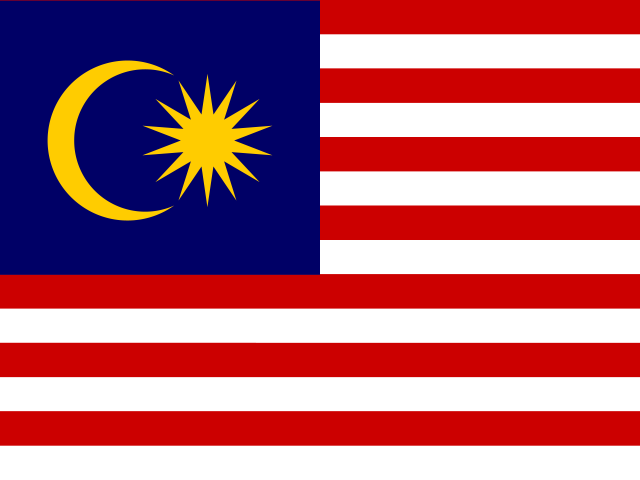
Bachelor of Medicine and Bachelor of Surgery (MBBS)
5 years — based on the Universiti Malaya Medical Programme
from 20,175 USD per year
An admission test — MSAT, MCAT or GAMSAT depending on the university
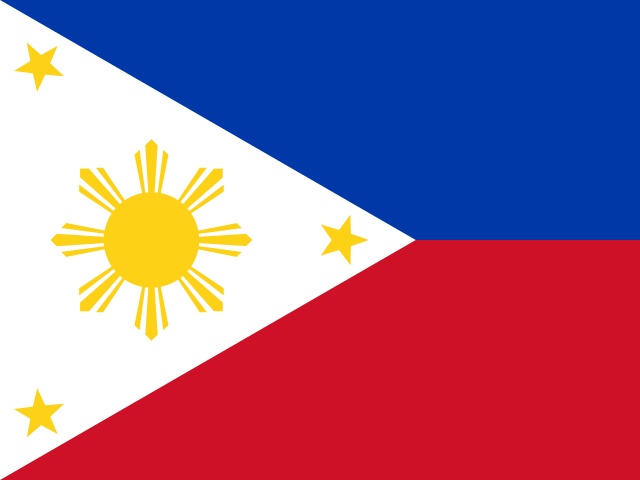
Doctor of Medicine (MD)
4 years, after you already hold a bachelor's degree
from 6,000 USD per year
Graduate entry: a bachelor's degree first, then the NMAT test
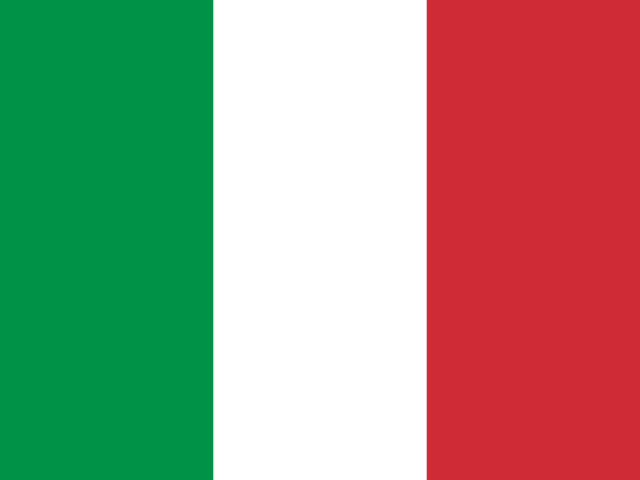
Medicine and Surgery (single-cycle, LM-41 class)
6 years — based on Bologna's English-taught program
from 150 EUR per year
One admission exam: the IMAT, taken in English
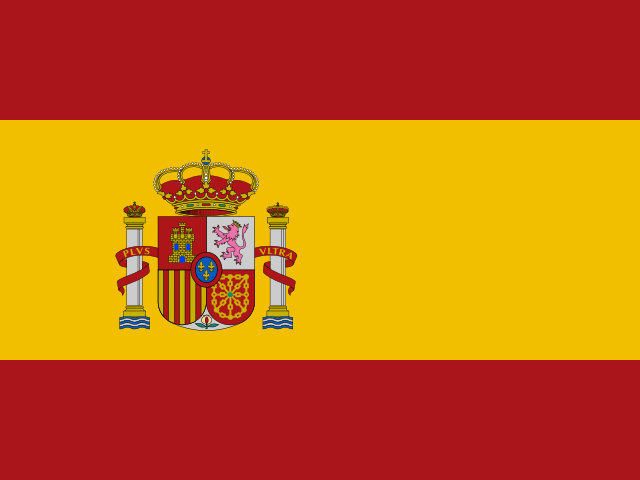
Grado en Medicina
6 years — based on the University of Barcelona
from 1,200 EUR per year
School credentials assessed by UNED; some universities add their own test
Medicine, State Examination (Staatsexamen)
6 years and 3 months by federal medical-licensing regulation
from 0 EUR per free
Apply through uni-assist; you will need strong German
Bachelor of Medicine, Bachelor of Surgery (MBBS)
Usually 5 years — titles and length vary a little between schools
from 15,840 GBP per year
The UCAT admission test, plus interviews
MB BCh BAO
5 or 6 years depending on the university — Trinity runs 5, UCD 6
from 19,350 USD per year
Non-EU students apply directly; the HPAT test only applies to EU applicants
How admission actually works
- 1
Shortlist destinations against your budget and your home country's own eligibility rule, if it has one — India's NEET requirement is the best-documented example; check the pillar page for your market for the equivalent.
- 2
Confirm the specific university's own entrance route — a named test (IMAT, UCAT, MSAT), an internal university assessment, or a documents-and-grades review. This varies by university, not just by country.
- 3
Apply with your attested academic documents — the attestation chain (which ministries and embassies need to sign off) differs by home country; your market's pillar page lists the specific chain.
- 4
Accept an offer, then apply for a student visa — timelines vary widely by destination, so build in weeks of buffer before the intake date.
- 5
Enroll, and from day one, plan for the return-home step — the licensing exam or internship requirement your home country applies to foreign medical graduates.
The money
Rough annual tuition bands, built from Global Admissions' sourced cheapest-program figures per destination — not a currency conversion, just where each country's own cheapest listed program tends to land. Use the currency selector above the comparison table to see any specific figure in your own currency.
| Band | Destinations | What it buys |
|---|---|---|
| Under ~$5,000/yr | Russia; a handful of China programs | The cheapest sourced tuition on Global Admissions — but only a small slice of China's programs are actually this cheap, so check the fee table before assuming. |
| ~$5,000-15,000/yr | China, Turkey, Georgia, Poland, Malaysia, Philippines | The largest band by program count — most of Global Admissions' catalog for these six countries sits here. |
| ~$15,000-40,000/yr | Italy, Spain, Germany, Poland, Turkey, and lower-end UK | Italy's public fees can be low, but admission runs through the competitive IMAT exam; Germany's public fees are close to free, but seats are competitive and mostly German-taught; an MBBS this cheap in the UK is rare. |
| $40,000+/yr | UK, Ireland | Standard undergraduate medicine at most UK and Irish medical schools. |
Coming home licensed
Across the origin markets Global Admissions has researched (India, Pakistan, Bangladesh, Nepal, Nigeria, Ghana, Kenya, Egypt), the same three-way choice shows up — even though the exact exam names and steps differ by country. See the full decision-tree explainer for the sourced, market-by-market version.
Return home and get licensed▾
- 1
Check your home regulator's rule for foreign medical graduates
Most of the markets Global Admissions has researched require a separate licensing or screening exam for anyone with a foreign primary medical qualification — India's FMGE and Pakistan's NRE are two sourced examples. This is rarely optional.
- 2
Complete any required supervised internship or housemanship
Several markets require this internship to happen specifically at home, after provisional registration — not before, and not entirely abroad. Bangladesh's BMDC and Ghana's Act 857 are two sourced examples.
- 3
Register with your national medical council
Full, independent practice generally requires entry in your home country's medical register — a foreign degree alone doesn't grant this.
Stay and practice in your destination country▾
- 1
Check that country's own licensing rules directly
This depends entirely on the destination's own medical regulator, which is a different regulatory domain from the origin-market packs this guide is built on. Verify directly with that country's medical council before assuming your degree alone qualifies you to practice there.
Aim for a third country▾
- 1
Expect a further licensing exam
Practicing in a third country (for example, the UK's PLAB or the US's USMLE pathway) typically means clearing that country's own licensing exam on top of your medical degree. Global Admissions doesn't yet have sourced pack data on these specific exams — verify directly with the relevant regulator before planning around one.
Scholarships, honestly
Rare and highly competitive — most applicants don't get this.
Across nearly every market Global Admissions has researched, a full scholarship for a first undergraduate MBBS is rare and competitive — most funding claims online are marketing. Real, narrower government-to-government routes do exist for some markets; see your market's pillar page for the sourced list.
Never miss an intake or scholarship deadline
Get an email when new deadlines, intakes, or scholarships match what you're looking for.
For students from…
Frequently asked questions
Which country is best for MBBS abroad?
How long does an MBBS or equivalent medical degree abroad take?
What does MBBS abroad typically cost?
Do I need to sit an entrance exam for MBBS abroad?
Is qualifying NEET compulsory for MBBS abroad?
Is studying MBBS abroad really more affordable than in India?
How do I know if a foreign medical degree will let me practice back home?
Are scholarships common for MBBS abroad?
What is the admission process for MBBS abroad?
How to verify this page
- PIB / Government of India — NEET requirement for FMGs
- Russia — duration
- Russia — entrance requirements
- Georgia — duration
- Georgia — entrance requirements
- China — entrance requirements
- Turkey — entrance requirements
- Turkey — duration
- Poland — entrance requirements
- Malaysia — entrance requirements
- Philippines — duration
- Philippines — entrance requirements
- Italy — duration
- Italy — entrance requirements
- Spain — duration
- Spain — entrance requirements
- Germany — degree
- Germany — duration
- Germany — entrance requirements
- United Kingdom — duration
- United Kingdom — entrance requirements
- Ireland — entrance requirements
- Ireland — duration
- Confirm the university appears on your home country's medical regulator list (e.g. NMC, PMDC, MDCN) before applying.
- Cross-check the tuition figure on the university's own official fee page — not a third-party agent site.
- Confirm the teaching language matches what you can actually study in (English-medium vs local-language track).
- Check the exact degree title awarded (MBBS vs MD vs Bachelor of Medicine) and whether it's recognized back home.
- Ask about the internship and clinical-rotation structure — some programs require it happen abroad, not at home.
- Understand your home country's return-home licensing rule (e.g. NEET, MDCAT, a screening exam) before you commit.